
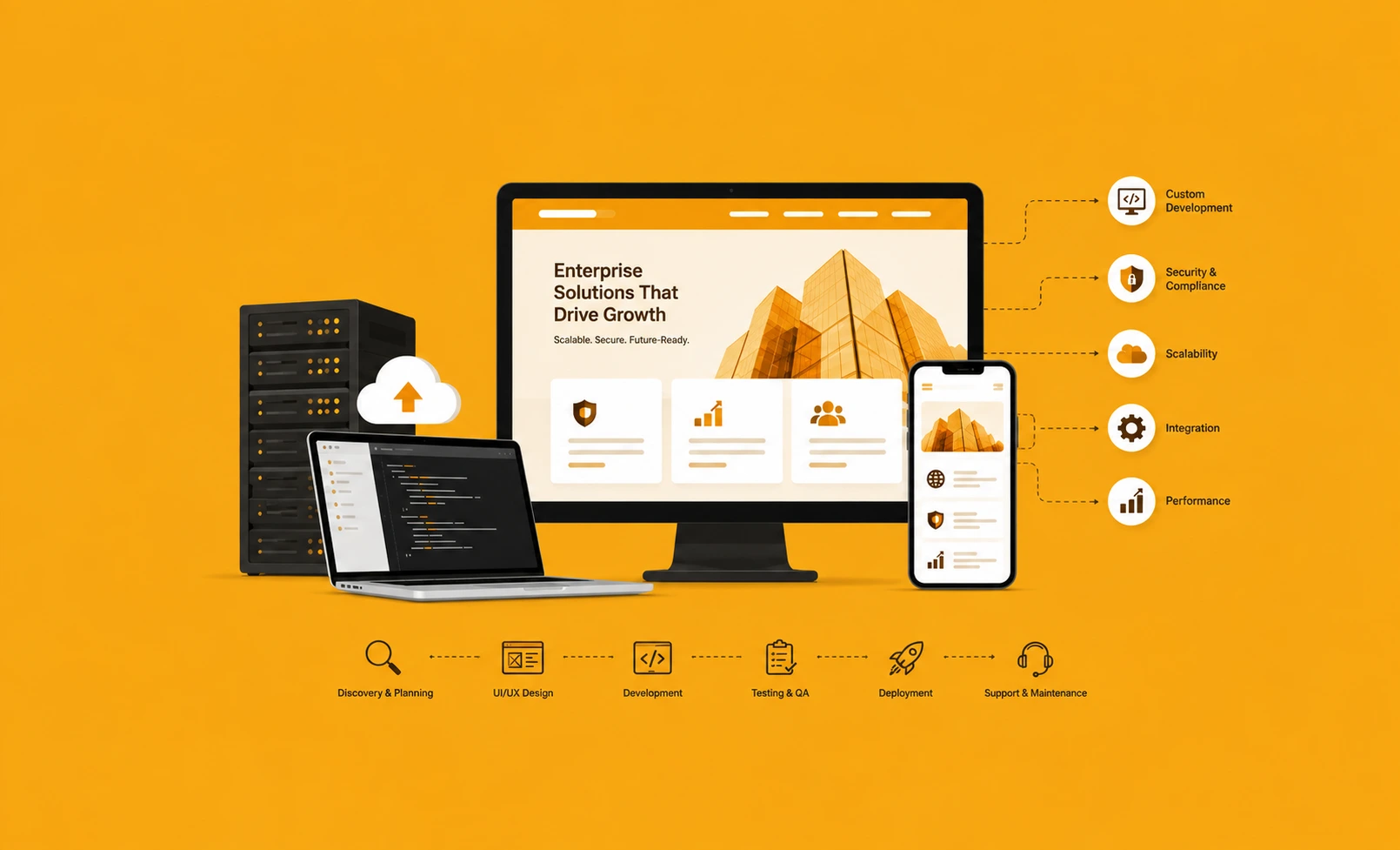
Enterprise website development isn’t really an “IT project” anymore, not in the way it used to be. It’s closer to a growth lever. Once a company starts operating across regions, departments, and different customer segments, the website stops being a brochure and starts being infrastructure. It needs to hold up under heavy traffic, talk to your CRM and ERP without breaking, support more than one language, and stay locked down security-wise while a dozen teams touch it at once.
So if you’re the one figuring out how to plan, build, or upgrade a large corporate site in 2026, here’s a practical walkthrough: the planning stage, the technology decisions, realistic timelines, and what things actually tend to cost.
What Is Enterprise Website Development?
Enterprise website development refers to the design, engineering, and deployment of large, complex websites built specifically for big organizations, such as multinational corporations, SaaS companies, financial institutions, and healthcare networks. A small business site doesn’t have to think about most of this. An enterprise platform usually does:
- Thousands, sometimes millions, of monthly visitors, with zero tolerance for slowdowns
- Multiple business units, brands, or regional sub-sites living under one shared architecture
- Integrations with internal systems, including CRM, ERP, HR, and marketing automation
- Role-based access so large content and marketing teams aren’t stepping on each other
- Compliance, security, and data privacy requirements that don’t leave much room for error
That level of complexity is exactly why this kind of project demands different planning than a standard website development engagement. You’re not really building a site. You’re building a digital ecosystem.
Key Features of a High-Performing Enterprise Website
A few traits tend to show up again and again in the platforms that actually hold up over time:
- High availability and uptime, backed by redundant hosting and CDN infrastructure
- Modular architecture, so new pages or sub-sites can be added without disturbing the core system
- Centralized design systems that keep every regional page on-brand
- Analytics and tracking built in from the start, not stitched on later
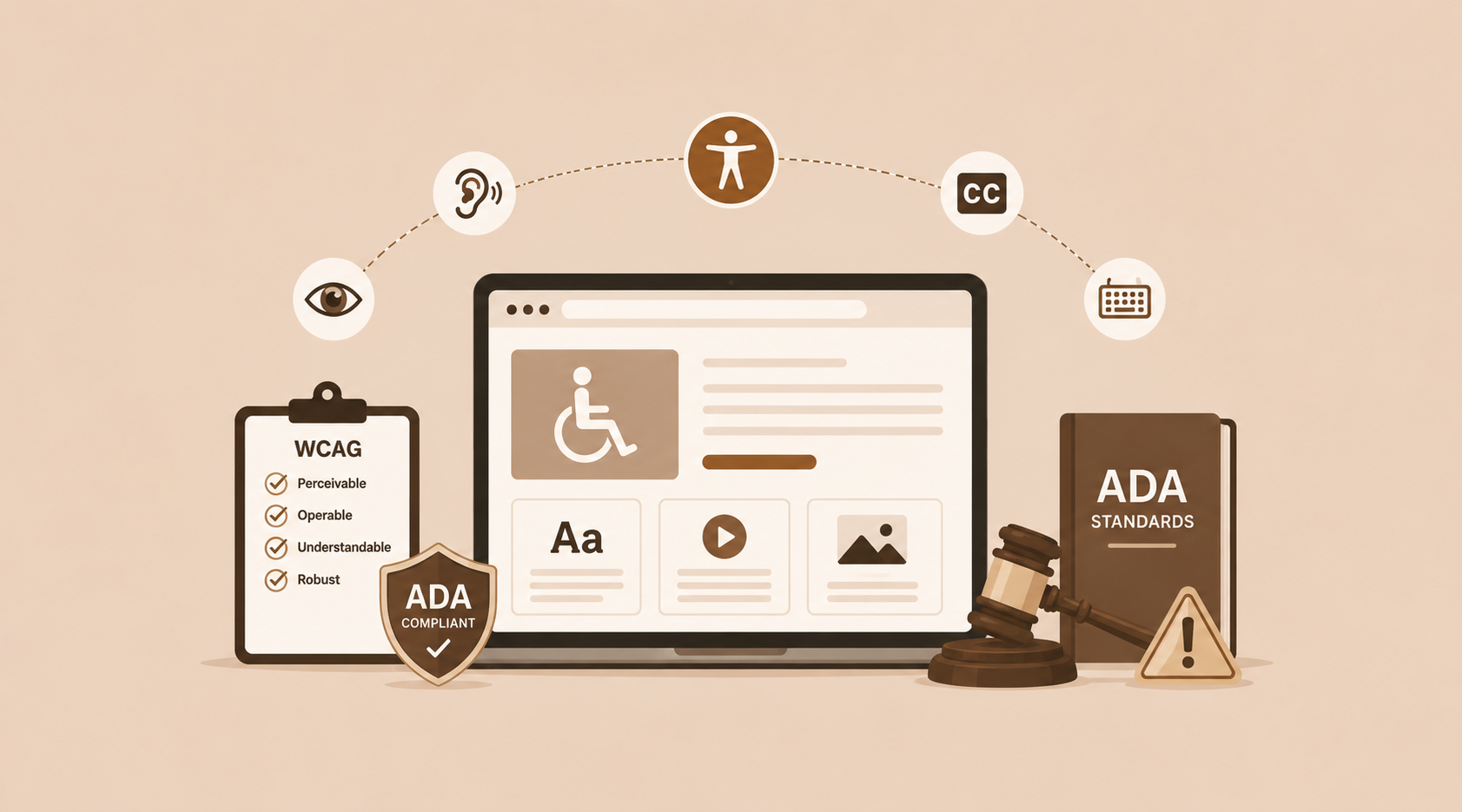
- Accessibility compliance (WCAG standards), to serve every user and reduce legal exposure
- Automated backups and disaster recovery, since downtime on an enterprise site isn’t a minor inconvenience
None of these are “nice to haves.” Skip them, and the platform ages badly fast.
Why Enterprises Need Custom Enterprise Web Solutions
Templated themes and drag-and-drop builders don’t hold up at this scale. A custom enterprise website is built around how your business actually operates, not around whatever a generic template assumes, which is why it keeps scaling as the company grows instead of hitting a wall.
A well-planned enterprise digital platform tends to give large businesses a few things at once:
- Scalability: infrastructure that doesn’t blink during traffic spikes from a launch or campaign
- Brand consistency: one design language across regional or divisional sub-sites
- Deeper integrations: direct connections into internal databases, payment systems, and analytics tools
- Stronger security: enterprise-grade protection against breaches and downtime
- Long-term flexibility: an architecture that absorbs new features without forcing a full rebuild
For companies dealing with large or complicated product catalogs, this usually overlaps with custom website development, and in retail or B2B commerce, it often extends into enterprise ecommerce platforms built on top of ecommerce website development frameworks.
Worth pointing out, “custom” doesn’t mean starting from a blank page on everything. Most projects lean on proven, already-tested components and build custom modules only where the business genuinely needs something different.
Core Enterprise Web Development Services
A capable enterprise web development company rarely sells you one deliverable. It’s usually a bundle of services working together. Here’s what tends to be included:
- Discovery and technical audits to map out current systems, pain points, and goals
- UX strategy and information architecture for content structures that span multiple departments
- Frontend and backend development on frameworks built to scale
- CMS implementation, so your internal teams can manage content without waiting on a developer
- API and third-party integrations with CRM, ERP, and marketing platforms
- Enterprise SEO structuring, built for large, sprawling site architectures
- Quality assurance and security testing
- Ongoing support and website maintenance
Put together, these enterprise web development services are what let a platform grow with the business, instead of needing a full rebuild every two or three years, which happens more often than you’d think.
How to Build an Enterprise Website: Step-by-Step Process
If you’re trying to figure out how to build an enterprise website, the first thing to understand is that it’s a phased effort, not a single sprint you knock out in a few weeks. Here’s roughly how the enterprise website development process plays out in practice:
1. Discovery & Requirement Analysis
Stakeholders from marketing, sales, IT, and compliance weigh in here, so the scope and success metrics reflect how the whole business works, not just one department’s wish list.
2. Information Architecture & UX Strategy
Enterprise sites can house thousands of pages. Getting the navigation, taxonomy, and UI/UX design right at this stage saves a painful, expensive restructuring project later.
3. Wireframing & Prototyping
Before anyone writes a line of code, layouts and user flows get validated through wireframing and prototyping. It’s cheaper to fix a wireframe than a finished page.
4. Technology Stack Selection
Frameworks, CMS, and hosting are chosen based on scalability, security, and how well they’ll play with existing systems.
5. Frontend & Backend Development
The user-facing interface and the server-side logic, APIs, and databases develop in parallel, so nothing sits waiting on the other half.
6. Integration with Business Systems
The site gets wired into CRM, ERP, marketing automation, and analytics platforms, so data actually flows between departments instead of living in silos.
7. Testing & Quality Assurance
Performance testing, security audits, cross-browser checks, load testing. Work that’s invisible when it goes right and very visible when it’s skipped.
8. Deployment & Launch
Usually a phased rollout, starting in staging before going fully live.
9. Maintenance & Continuous Optimization
Monitoring, updates, and feature enhancements continue through structured website maintenance packages, which is what keeps the platform secure and current after launch.
This structured process is really what separates a platform that scales smoothly from one that starts needing emergency fixes six months in.
Best Technology Stack for Enterprise Websites
There isn’t one “correct” answer here. The best technology stack for enterprise websites depends on what you already have, what your team knows, and where the roadmap is headed. That said, a handful of combinations tend to perform reliably at scale:
- Frontend: React JS or Angular for dynamic, component-based interfaces
- Backend: Node.js, PHP, or Python, depending on what’s already running
- Frameworks: Laravel for fast, secure development on the PHP side
- Progressive capabilities: A Progressive Web App (PWA) layer for app-like performance without a separate native build
- Web applications: Custom web application development for internal dashboards, client portals, or self-service tools
As business units try to move independently, a lot of enterprises end up looking at headless or API-first setups. That’s a big enough topic on its own, worth a full breakdown in Headless CMS vs Traditional CMS for Enterprise Websites, which we’re planning as a follow-up piece.
Choosing the Right Enterprise CMS for Large Business
Content velocity becomes a real problem at this scale. Dozens of contributors, several layers of approval, regional variations of the same content. All of it needs to coexist without turning into chaos. An enterprise CMS for large business should be able to handle:
- Role-based permissions and multi-user workflows
- Multilingual and multi-site content management
- Solid SEO and metadata controls
- Headless or hybrid delivery for omnichannel publishing
- Reliable uptime and consistent security patching
WordPress still holds up well even at enterprise scale, as long as it’s configured properly: the right architecture, custom plugins, and a solid caching layer. It’s flexible enough to handle complicated workflows without locking you into a rigid, proprietary system you can’t easily move away from later.
Enterprise Web Development Cost
Enterprise web development cost swings quite a bit depending on scope, integrations needed, and how many sub-sites or regions are involved. As a rough guide:
- Mid-complexity enterprise sites (custom CMS, a moderate number of integrations) generally fall between $25,000 and $75,000
- Large-scale platforms with deep system integrations, multilingual support, and custom applications can run $75,000 to $200,000+
- Ongoing maintenance and optimization usually adds a recurring monthly or annual line item on top of that
It’s tempting to compare quotes purely on the bottom-line number, but that’s rarely the useful comparison. What’s actually included, such as integration support, testing depth, and post-launch maintenance, tends to matter more over the life of the project.
How Long Does Enterprise Website Development Take?
Timelines vary with scope, but most enterprise projects settle into a fairly similar rhythm:
- Discovery and planning: 2–4 weeks
- Design and prototyping: 3–6 weeks
- Development and integrations: 8–16 weeks
- Testing, QA, and launch prep: 2–4 weeks
Add it up, and a full-scale enterprise project typically lands somewhere between 4 and 8 months, depending on how many integrations are involved, how much content needs migrating, and how many approval cycles the project has to move through. Simpler builds move faster. Multi-region platforms with heavy compliance requirements tend to run longer.
It’s also worth budgeting time for your own team’s review and approval cycles. Delays in internal sign-off are one of the more common reasons timelines stretch past the original estimate.
How to Choose the Right Enterprise Web Development Company
Not every agency is actually built to handle enterprise-scale work, even if their pitch deck says otherwise. When evaluating an enterprise web development company, a few things are worth checking closely:
- Real experience with large, multi-department platforms; ask to see a portfolio of comparable projects
- Technical depth across frontend, backend, and integration work, not design alone
- A documented process for discovery, QA, and deployment, not something improvised each time
- Post-launch support, backed by an actual maintenance agreement
- Flexible engagement models, including the option to hire dedicated developers when you need to extend your own team
A good partner also thinks past launch day, planning ahead for advanced personalization or AI-driven content recommendations, a topic we’ll cover in an upcoming guide on AI Personalization for Enterprise Websites.
Price shouldn’t be the only factor, but transparency around it matters. A trustworthy partner walks you through how an estimate breaks down: design, development, integrations, QA, and support, instead of handing over one lump number.
Final Thoughts
Enterprise website development is a long-term bet on how your organization sells, communicates, and operates online, not a one-off project you check off a list. Getting the process, the technology stack, and the partner right from the start saves a lot of time and money down the road. If your team is planning a new platform or weighing a redesign, contact us for a free consultation to talk through your requirements and next steps.






 +91-7982030802
  +1(315) 585-1155