

Introduction
If you’re planning to launch an online store, one of the first questions that usually comes to mind is:
How much does it cost to build an eCommerce website?
The honest answer is: It depends.
Some small online stores can be built for just a few thousand dollars, while large enterprise platforms can cost $10,000 or more. The difference mainly comes down to factors such as the platform you choose, the number of categories, the number of products and their variations you plan to sell, the features you need, and how customized your website is.
For many business owners, this pricing difference can be confusing. Different agencies often quote very different budgets. Some promise a complete store for $2,000, while others estimate $50,000 or more for a similar project.
To understand these differences, it helps to first understand how websites are actually built and what goes into the development process. If you’re new to this topic, this beginner-friendly guide explains the fundamentals of website development.
So how do you determine what a realistic budget looks like for your business?
In this guide, we’ll break down the actual cost of eCommerce website development, the key factors that influence pricing, and how businesses can build a scalable online store without overspending.
Average eCommerce Website Development Cost
| Type of Website | Estimated Cost |
| Basic template store / small business store (WordPress) | $1,500 – $2,500 |
| Shopify eCommerce setup with Free Theme | $1,800 – $3,000 |
| Custom eCommerce website | $2,500 – $5,000 |
| Shopify with theme customization | $3,000 – $10,000 |
| Small Marketplace eCommerce Website | $5,000 – $10,000 |
| Enterprise eCommerce platform | $10,000+ |
For most small to mid-sized businesses (approx 90% businesses), the typical investment usually falls between $1,500 and $10,000, depending on features, customization, and platform choice.
A simple store using a pre-built template may be relatively inexpensive, but companies that want advanced features, automation, and scalability usually invest more.
Businesses that plan to scale their online store often rely on professional development teams to build a reliable infrastructure.
What Actually Drives the Cost of an eCommerce Website?
1. The Platform You Choose
The platform is the foundation of your online store.
Some businesses use hosted platforms like Shopify, while others prefer open-source or custom-built systems.
Common options include:
- WordPress + WooCommerce
- Shopify
- Magento
- BigCommerce
- Custom-built frameworks
Hosted platforms (Wix, etc.) can be cheaper initially, but they may limit customization later. Custom development gives you full control but requires a larger upfront investment. If you are still learning about how websites are built, it’s helpful to understand the basics of development first. This guide explains the fundamentals clearly.
2. Website Design and User Experience
Design is often underestimated, but it plays a huge role in how customers interact with your store.
A well-designed eCommerce website includes:
- Intuitive navigation
- Mobile friendly layouts
- Fast loading pages
- Optimized product pages
- Smooth checkout process
Using a ready-made theme can save money, but a custom design tailored to your brand usually delivers better conversion rates.
3. Product Catalog Size

The number of products in your store also impacts the development cost and complexity.
- 1–10 Products: Simple setup with basic product pages and cart functionality.
🟢 Low complexity - 50–500 Products: Requires structured product data, filtered search, and product variations.
🟡 Medium complexity - 500–10K Products: Needs optimized search, custom technology, and possible ERP integration.
🟠 High complexity - Enterprise Catalog: Large-scale systems with microservices, global CMS, and ERP/API integrations.
🔴 Very high complexity
In general, larger product catalogs require more advanced databases, faster search systems, and better inventory management, which increases development cost. 💻📈
4. Custom Features and Functionality
This is where costs can increase significantly.
Some businesses only need a basic store, while others require advanced features like:
- Subscription billing
- Multi-vendor marketplaces
- Personalized product recommendations
- Advanced search filters
- Loyalty programs
Each additional feature adds development time.
However, these features can also improve customer experience and increase sales.
5. Integrations With Other Tools
Most online stores need to connect with other systems.
Common integrations include:
- Payment gateways
- Shipping providers
- CRM systems
- Accounting software
- Marketing automation tools
While integrations make operations easier, they also add to development costs.
eCommerce Website Cost by Platform
Different platforms come with different pricing models.Here’s a rough comparison:
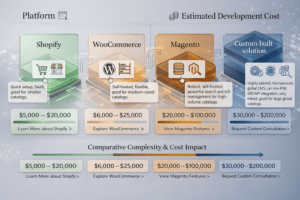
NOTE: The figues mentioned in the above picture is for reference purpose only.
The cost of building an eCommerce website depends on the platform and level of customization.
- Shopify: Quick setup (SaaS), ideal for small catalogs.
💰 $1,800 – $10,000 - WooCommerce: Self-hosted and flexible, suitable for medium-sized stores.
💰 $1,500 – $5,000 - Magento: Powerful and scalable, best for large product catalogs.
💰 $2,000 – $10,000 - Custom-built solution: Fully tailored platforms with advanced integrations like ERP, PIM, and APIs.
💰 $5,000 – $10,000
Overall, more customization and advanced features increase the development cost. 💻💰
Many businesses prefer WordPress with WooCommerce because it offers flexibility and full control over customization.
Breaking Down the Development Cost
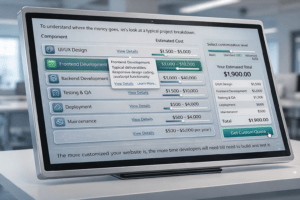
NOTE: The figues mentioned in the above picture is for reference purpose only.
Hidden Costs Many Businesses Forget
One of the biggest surprises for first-time store owners is that development isn’t the only cost.
Running an online store also involves ongoing expenses.
Some common ones include:
Hosting
Your website needs reliable hosting to handle traffic and transactions.
Payment Gateway Fees
Payment providers usually charge transaction fees.
Security
Security tools like SSL certificates and fraud detection are essential.
Maintenance
Regular updates keep your store secure and functioning smoothly.
Planning for these costs early prevents unexpected surprises later.
How Businesses Can Reduce Development Costs
Building an eCommerce website doesn’t have to break the bank. Here are a few smart strategies businesses use to manage costs.
Start With a Minimum Viable Product
Instead of launching with dozens of features, start with the essentials.
A Minimum Viable Product (MVP) includes:
- product listings
- checkout functionality
- payment processing
- mobile responsiveness
Additional features can be added later as the business grows.
Focus on What Actually Drives Sales
Some businesses spend too much on unnecessary features.
Instead, prioritize elements that directly impact conversions, such as:
- faster page load speeds
- better product images
- optimized checkout flows
Work With Experienced Developers
Choosing the right development partner can actually save money in the long run.
Experienced teams build scalable solutions that reduce future redevelopment costs.
How Long Does It Take to Build an eCommerce Website?

NOTE: The figues mentioned in the above picture is for reference purpose only.
Choosing the Right eCommerce Development Company
Selecting the right development partner is just as important as choosing the platform.
Look for a team that offers:
- Proven eCommerce experience
- Strong portfolio
- Scalable development practices
- Post-launch support
The right agency will help you build a store that not only looks good but also performs well.
Final Thoughts
The cost of building an eCommerce website can vary widely depending on your business goals, features, and platform choice.
For most businesses, the investment falls somewhere between $5,000 and $25,000+, depending on how advanced the store is.
While it might be tempting to choose the cheapest option, the better approach is to focus on long-term scalability and user experience.
A well-built eCommerce website becomes the foundation of your digital business – helping you attract customers, improve conversions, and grow revenue over time.
If you are planning to launch or upgrade your online store and want expert guidance on the right technology, features, and budget planning, you can reach out to the expert team for professional consultation.








 +91-7982030802
  +1(315) 585-1155