

The business landscape in Austin is quickly changing. With tech firms in East Austin and well-known retail businesses on South Congress, every firm has one thing in mind – getting their brand on the device that users check more than 100 times a day, their smartphone. An app for mobile devices isn’t an option anymore; it’s the face of your business. However, creating one for both iOS and Android used to mean doubling your costs and time.
That’s where React Native app development changes the equation. Instead of building two separate apps with two separate codebases, businesses can now build once and deploy everywhere, giving Austin’s growing companies faster market entry, lower development costs, and an app that keeps up with how quickly the city’s business landscape moves.
In this guide, we’ll break down what React Native is, why it’s become the go-to choice for mobile app development react projects, what it costs, and how Austin businesses specifically are using it to grow.
What Is React Native, and Why Does It Matter for Austin Businesses?

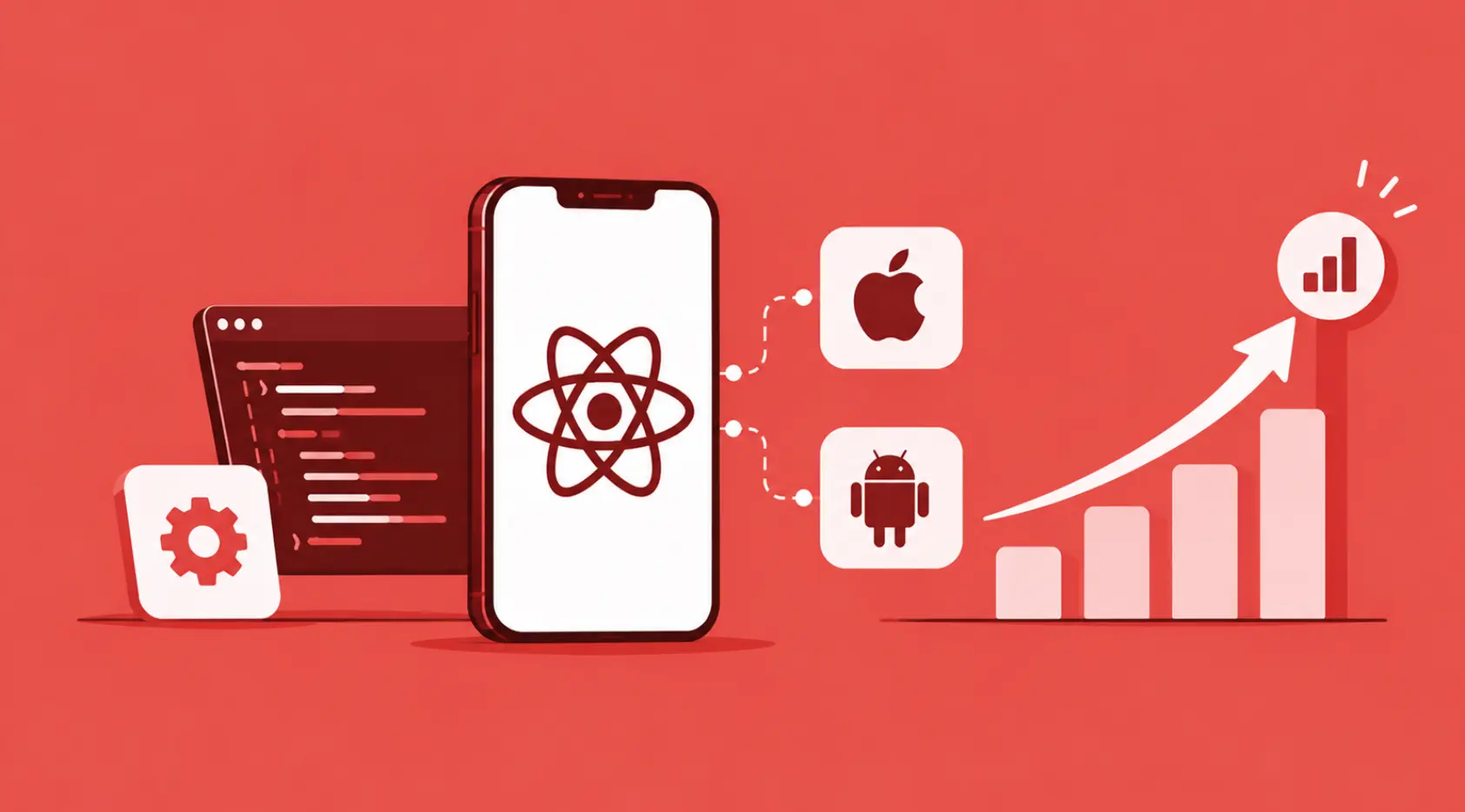
React Native is a framework that uses JavaScript and React as programming languages. It allows for developing mobile applications that are built once and can then be compiled to both iOS and Android platforms. It differs from the previous versions of cross-platform frameworks, which allowed to make a website and put it in an app-like shell, since React Native allows to create UI components that work in the same way as in native applications.
React native mobile app development services matter to Austin-based businesses due to practical reasons: the highly competitive environment requires fast launches and efficient use of resources while keeping the burn rate low, and having a single codebase allows for doing just that. In addition, there is a wide developer community of React and JavaScript in Austin, and having one codebase will help in managing one development team instead of two.
This has a direct impact on any kind of business that operates in downtown Austin or greater metropolitan area: restaurants, healthcare companies, home services companies etc.
Create Mobile App with React Native: The Business Case
In cases when people running businesses in Austin wonder how to create mobile app with react native, it’s common practice to start with the same question – why don’t they develop native applications separately for iOS and Android? Well, here is the explanation. Developing a traditional application will require hiring two teams – one which will be working on Swift or Objective-C to develop an application for iOS, another one developing on Kotlin/Java to work on an Android application. So, it will be two code bases you will have to manage, write, test, and maintain.
React Native allows developers to create the core application logic once. Moreover, 90% or even more of the code can be reused for both iOS and Android development, while changes will be made only in case when something needs to be implemented separately. This is the exact reason why nowadays many companies are searching for ways to create a mobile app with react native.
And here is the list of benefits – faster iterations due to simultaneous updates of both platforms, unified user experience on Android and iOS and smaller technical debt.
App Development with React Native: How the Process Works

In case you have never dealt with our frameworks before, being aware of the whole development process will help you to understand what to expect. At first, a project begins with the discovery and planning phases, where business goals, target audience, and key features are defined. After that, UI/UX design is created with the help of the possibility of making fully customizable UI provided by React Native, which allows screens to be native on both operating systems and match your brand. During development, developers code the application using JavaScript and React Native components library and integrate it with your backend, APIs and third-party services such as payment gateways or CRMs. After testing on real devices to check the performance on both systems, the app is published on the Apple App Store and Google Play Store. After launching, updates are necessary to keep your app relevant as your business is developing.
The effectiveness of create mobile app react native projects is especially obvious during the development phase when one project replaces two.
React Native Android Apps: What Austin Businesses Need to Understand
Android is a significant player in the mobile world and there are a large number of Austin companies that cater to customer segments in which the use of Android devices is just as much, if not even more prevalent than iOS devices. This is particularly true of companies that serve a broader Austin metro demographic segment than a tech industry niche.
The performance of react native android apps is very good since the framework has been developed with genuine cross platform parity in mind. This means that the apps created using react native compile down to native components of the Android OS and therefore do not suffer from the slow speed that earlier hybrid frameworks suffered. They also have full access to native features such as the camera, GPS, push notifications and device storage, which is important for companies looking to develop location based services, delivery apps or field service apps.
For Austin businesses in industries like food delivery, local services, or logistics, where a large share of the customer base may be on Android, this isn’t a secondary consideration. It’s often central to the app’s success.
React Native for iOS Development: Meeting Apple’s High Bar
Android is a considerable player in the mobile industry, and most Austin firms serve clientele that uses Android just as much as, if not even more than, iOS. This is particularly true for those serving a larger demographic group in Austin than an industry-specific one.
Apps developed for android using react native work great because react native was developed as a completely cross-platform framework. Apps created using react native are translated into native Android components and thus avoid the poor performance associated with older cross-platform development tools. Additionally, react native gives apps full access to native Android APIs, including camera, GPS, push notifications, and device storage, which is important when developing location-based services, delivery applications, and field service applications. The flexibility of the layout system in react native is particularly helpful in dealing with the fragmented nature of android devices.
For Austin-based companies in the logistics, food delivery, or local service industries, this is an issue that needs to be considered from the outset.
React Native for Hybrid App Development: Clearing Up the Confusion
There is an issue that needs clarification. The common misconception about react native hybrid app development relates to the fact that there is a wrong comparison between react native technology and other hybrids like Cordova or Ionic. The latter technologies are considered the old way to develop hybrid applications that run on a website loaded into a wrapper (WebView).
React Native does not work that way. Although it can be regarded as a hybrid/cross-platform technology due to using one codebase for development, it uses a special tool (the bridge) to render the components in native UI instead of Webview.
For Austin business owners who try to make a choice, this information is crucial. Using React Native means having the opportunity to enjoy the benefits of development with one codebase, having a unified team, building applications faster while maintaining native performance.
React Native App Development Cost: What Austin Businesses Can Expect

The question about cost is usually always the first one for any business owner, and with good reason. React Native mobile application development cost depends on a number of different things: the complexity of the app (a simple app will cost significantly less than a complex one with real-time functionalities or integrations in the backend), design requirements (custom branding, custom UI is more expensive than using standard components), third party integrations (any payment gateway integration, CRM integration, booking functionality, etc), backend requirement (having a custom backend developed instead of working with the already available APIs will cost extra), as well as maintenance and update costs.
Using the simplest classification, a simple application with no backend needs will be on the lower end of the pricing spectrum, applications with medium complexity that need custom UI and backend development in some measure fall under the category of more costly options, and the most complex applications with real-time functionalities and multiple integrations will be on the high end of the spectrum.
The good news is that because React Native eliminates the need to build separate iOS and Android codebases, total cost is typically lower than fully native development for comparable functionality, often significantly so. For Austin businesses working with fixed budgets or seeking outside investment, that efficiency can make the difference between launching this year or pushing the project out indefinitely.
React Native Mobile App Development Services: Choosing the Right Partner
With React Native capabilities and rough cost estimate in hand, the next task is selecting a competent team to develop your application. All react native mobile app development services are not created equal; the quality of service provider will reveal itself quickly through delayed project timescales, buggy product release, and applications requiring a full rewrite within a year or two.
Make sure the company has a true portfolio of published applications on the App Store and Google Play (as opposed to mocks), actual experience launching software both on iOS and Android platforms, open communication and transparency of sprints and deadlines, a post-launch support strategy, and relevant industry expertise. Given the unique blend of tech talent and diversity of industries operating out of Austin, there is no shortage of potential partners, but the right one should feel like an extension of your own team rather than a vendor.
Why Austin Businesses Are Growing Faster with React Native
To summarize, the most successful Austin businesses in terms of mobile app growth have something in common: They selected an architecture allowing them to go live on both operating systems at once without increasing their budget twice, cooperated with a development team that knew not only how to develop an application but also how to market it, and saw this product as an asset rather than a project.
In the light of all of the above, React Native provides a realistic opportunity for all Austin businesses, from new ventures operating from the heart of the city to already existing companies, to create a quality mobile presence without spending money and time that would be required to create a native application.








 +91-7982030802
  +1(315) 585-1155