
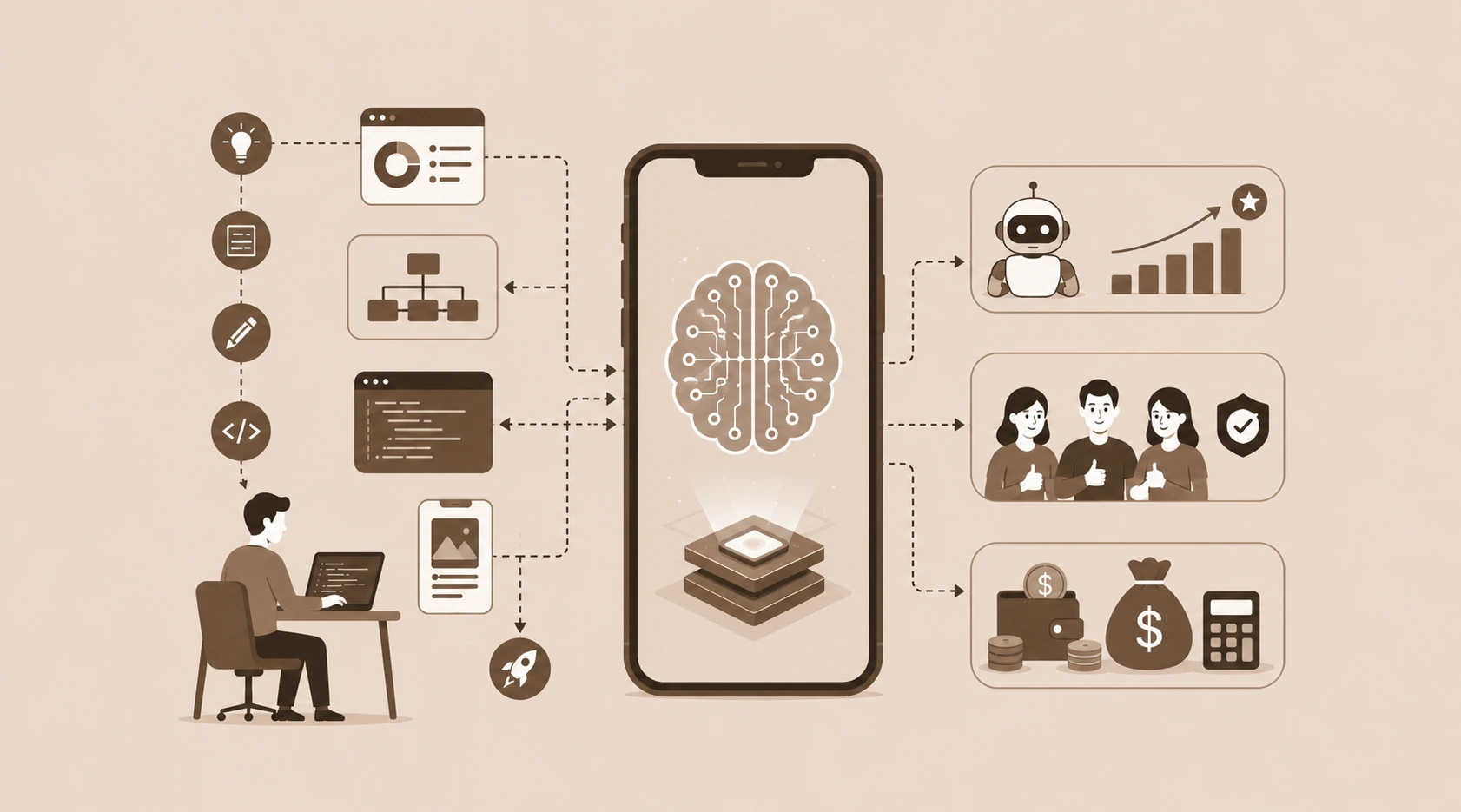
Most articles about AI app development start with something like “artificial intelligence is transforming industries worldwide.” You’ve read that sentence a hundred times. Let’s skip it.
What I actually want to talk about is the practical side of this, the stuff that matters when you’re a business owner or product lead who’s been asked to make a call on whether or not to build AI into your next app. Because honestly? That decision is a lot less mysterious than most of the content out there makes it seem. There are real questions, real tradeoffs, and real numbers to consider. That’s what this guide is going to cover.
We’ll get into what AI application development actually looks like, which features tend to show up most in well-built products, what the costs look like across different project types, the benefits businesses actually report, and how the development process plays out from kickoff through launch. And we’ll keep it grounded in how things work for companies operating in the US market right now, not hypothetical enterprise use cases from three years ago.
What Is AI App Development?
Short version: it’s building apps that learn and adapt rather than just executing fixed code. Longer version, worth knowing if you’re about to spend real money on it.
Traditional software development means writing explicit rules. If X happens, do Y. Every scenario gets coded, every exception gets handled manually. It works fine for predictable processes. But once your product needs to handle inputs that vary wildly, learn from user behavior, or make judgment calls at scale, rule-based systems hit a wall pretty fast.
AI-powered app development takes a different approach. You feed the system examples, lots of them, and it figures out the underlying patterns on its own. Then when new data comes in, it applies what it learned to make predictions or decisions without needing a developer to spell out every step.
What this ends up looking like in practice is pretty varied. A logistics company using it to predict delivery delays before they happen. A healthcare startup using it to flag patients who might need follow-up care. A retail brand using AI mobile app development to show each customer a genuinely different homepage based on what they’re actually likely to buy. Same underlying idea, wildly different applications.
Key Features of AI-Powered Apps
There’s no master list of features every AI app needs. What you build depends on your users, your data, and the specific problem you’re solving. That said, these capabilities show up across most solid AI-powered app development projects, and understanding them helps when you’re scoping a build:
1. Natural Language Processing (NLP)
NLP is what makes it possible for apps to understand text and speech the way humans use them, sloppy grammar, abbreviations, implied meaning and all. It’s behind search features that actually surface relevant results, chatbots that don’t frustrate people into leaving, voice interfaces, and tools that pull insights out of thousands of customer reviews without a human reading each one. If your app communicates with users in any kind of open-ended text or voice format, NLP is likely involved.
2. Machine Learning Models
The core engine in most AI application development work. A machine learning model trains on historical data, learns the patterns, and then applies those patterns to new inputs. Fraud detection, recommendation engines, churn prediction, dynamic pricing. What makes ML particularly compelling as a business investment is the compounding effect: the model improves as more data flows through the system, meaning the app literally gets smarter over time without the developer rewriting anything.
3. Predictive Analytics
One of the most immediately legible benefits for business stakeholders, because the value proposition is obvious: stop reacting to problems after they happen and start catching them early enough to do something about it. Inventory shortfalls, sales slumps, customer churn, equipment failures. Predictive analytics surfaces these signals in advance. For industries where acting a week earlier changes the outcome significantly, this feature more than pays for itself.
4. Computer Vision
Computer vision lets apps interpret images and video. Virtual try-on features in retail. Defect detection in manufacturing. Diagnostic image analysis in healthcare. Document scanning and automated processing. The APIs available today make this far more accessible than it was even a few years ago, you don’t need a team of research scientists to build a product with solid computer vision capabilities anymore.
5. Personalization Engine
This is the feature users notice most, even when they can’t articulate why. An app that feels like it was built for them. Content, product recommendations, messaging, UI layout, all of it shaped by how they actually behave rather than what a marketing team assumed they’d want. Done well, it’s the difference between an app people open daily and one they forget about after three days.
6. Automation and Smart Workflows
Not every AI win is a flashy customer-facing feature. Sometimes the most valuable thing you can build is something users never see: automated document routing, intelligent ticket triage, AI-driven scheduling, invoice processing that runs without anyone touching it. For operations-heavy businesses, this kind of behind-the-scenes automation can free up more time than almost any other investment in the product.
7. Real-Time Decision Making
Some use cases have zero tolerance for latency. A fraud detection system that takes thirty seconds might as well not exist. A pricing engine that adjusts hours after demand shifts misses the point. Real-time AI decision-making is technically demanding, requires careful infrastructure design, and costs more to build well. But for the right application, it’s genuinely difficult for a competitor to match once you have it working.
From personalized user experiences to automated workflows, we build AI-powered apps that deliver measurable results for businesses across the US.
Explore Our App Development ServicesBenefits of AI App Development
Keeping this grounded. These aren’t projections from an analyst report, they’re the outcomes businesses actually describe after going through the AI app development process:
- Engagement and retention improvePersonalized experiences reduce the friction that makes users look for alternatives. The apps with the best retention numbers almost universally have AI working somewhere underneath.
- Teams operate more efficientlyAutomating high-volume, low-judgment tasks means your people spend time on work that actually benefits from human thinking. That’s a meaningful shift in how a team operates day to day.
- Data starts driving decisions instead of hunchesPricing, inventory, marketing spend, product direction. All of it sharpens when you’re working from patterns the model surfaced, rather than gut instinct and last quarter’s spreadsheet.
- Unit economics improve over timeThere’s an upfront cost, no question. But the businesses that have gone through this process consistently report that reduced error rates, lower labor costs, and faster processes deliver a real return within a reasonable timeframe.
- Growth stops requiring proportional headcount increaseswell-built AI system handles ten times the volume without ten times the people. That’s a structural advantage that compounds as the business grows.
- You create distance from slower-moving competitorsMost small and mid-size businesses haven’t done this yet. Building AI into your product now means you’ll be two to three years ahead when your competitors finally start paying attention.
- Consistent availabilityAI-powered features don’t have off days, don’t call in sick, and deliver the same quality at 2am on a Sunday as they do at 10am on a Tuesday.
BinaryMetrix mobile app development services include AI-capable builds across a range of industries, worth looking at if you want a sense of what this can look like for your specific type of product.
How to Develop an AI App: A Step-by-Step Process
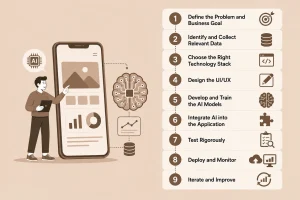
The AI app development process differs from a standard software build in ways that matter practically. Here’s how a well-run project typically moves:
Step 1: Define the Problem and Business Goal
This is where most projects actually succeed or fail, and it has nothing to do with technology. Vague goals produce vague products. “Improve customer experience” is not a goal you can build toward. “Reduce average support resolution time from 8 hours to under 2 hours” is. The difference between those two framings shapes every downstream decision from technology selection to how you evaluate whether the project worked.
Step 2: Identify and Collect Relevant Data
No getting around this one. AI runs on data, and the quality of that data determines what the model can actually do. This phase involves auditing what you already have, identifying gaps, and figuring out the path to fill them. A thing worth knowing upfront: teams that skip thorough data assessment before model development almost always end up circling back to fix data problems mid-build, which is significantly more expensive than dealing with it at the start.
Step 3: Choose the Right Technology Stack
The stack decision has long-tail implications. Python is the de facto standard for machine learning work. Node.js handles API-heavy, real-time backend architectures well. The right combination depends on how much custom model development is involved, your team’s existing expertise, performance requirements, and where you realistically expect to take the product in two to three years. A good development partner will walk you through the tradeoffs rather than defaulting to whatever they’re most comfortable with.
Step 4: Design the UI/UX
A consistent failure mode in AI projects: the model performs well in testing and the interface makes it completely unusable for real people. AI introduces specific UX challenges because the system makes decisions users can’t always see or verify, so the design has to make those decisions feel trustworthy. BinaryMetrix has a dedicated UI/UX team focused specifically on translating technical complexity into interfaces that feel intuitive rather than intimidating.
Step 5: Develop and Train the AI Models
This is the core technical work, and it rarely moves in a straight line. Models get built, trained, tested, and adjusted. Outputs that looked strong in controlled testing behave unexpectedly against real-world inputs. Edge cases surface that nobody thought to plan for. Budget time for iteration here because projects that don’t tend to hit nasty surprises very close to launch, which is the worst possible time to discover a model problem.
Step 6: Integrate AI into the Application
Getting a model working in isolation is one thing. Connecting it to a live application, with a real frontend, real backend services, and real third-party integrations, is where the integration complexity shows up. For mobile products specifically, there are platform-level decisions about how the AI layer interacts with device hardware. BinaryMetrix handles both iOS app development and Android app development with AI integration designed into the architecture from day one rather than treated as an afterthought.
Step 7: Test Rigorously
Testing an AI application has more surface area than testing a standard app. Functional behavior, yes, but also model accuracy across diverse input types, performance under realistic load, outputs at edge cases, and how actual users interact with features they’ve never seen before. Skimping here is one of the most reliable ways to launch something that falls apart in the first two weeks.
Step 8: Deploy and Monitor
Launch day opens a new chapter rather than closing the project. AI models drift as real-world data evolves away from what the training data represented. Good post-launch monitoring catches performance degradation before users notice it. The teams that build solid observability into their systems from the start are the ones that fix problems in hours rather than discovering them in negative reviews.
Step 9: Iterate and Improve
Post-launch is where the investment starts paying long-term dividends, if the team treats it seriously. New user data, evolving business requirements, and real-world feedback all feed back into the improvement cycle. The AI apps with the best long-term track records are built on continuous iteration, not on a single launch and a maintenance contract.
How Much Does AI App Development Cost?
Broad answer first: anywhere from $15,000 to well north of $200,000 depending on what you’re building. Here’s what that actually breaks down to:
- Entry-level AI apps such as chatbots on existing APIs or basic recommendation logic, typically run $15,000 to $40,000 with timelines of two to four months. These projects use pre-trained models and available APIs, which keeps costs manageable without sacrificing meaningful functionality.
- Mid-complexity AI apps including predictive dashboards, NLP-powered tools, and behavior-driven personalization, usually land in the $40,000 to $100,000 range with four to eight month timelines. Custom model development and data pipeline work account for most of the added cost.
- Enterprise-grade AI systems with custom ML pipelines, real-time decision engines, or computer vision components regularly exceed $100,000 and can run a year or more in development. That investment reflects genuine engineering depth at every layer.
What reliably pushes costs up regardless of tier: data that needs significant cleaning before it’s usable, building separate native apps for both platforms instead of a cross-platform solution, complex third-party integrations, and compressed timelines that require scaling up the team. The single most expensive mistake in AI projects is underscoping the discovery phase.
Every project is different. Share your idea with us and we'll give you a clear, honest estimate based on your actual requirements, no guesswork, no inflated numbers.
Get a Custom Project EstimateNative vs. Cross-Platform for AI Mobile App Development
Going native, Swift for iOS and Kotlin for Android, gives you the deepest hardware access. That matters when your AI needs to run on-device: real-time image processing, voice recognition, features that need to function offline. The cost is maintaining two separate codebases.
Cross-platform frameworks like Flutter and React Native let you build once and deploy on both platforms. For AI features that run server-side and communicate over APIs, this typically works without meaningful performance tradeoffs, and it costs noticeably less both to build and maintain. The nuanced conversation happens when on-device AI performance becomes a genuine requirement. A development team with experience in both paths should help you think through which choice fits your specific situation rather than defaulting to a preference.
What Is Next in AI App Development?
A few areas that will shape where AI application development goes over the next few years:
- How AI is Transforming E-Commerce AppsVisual search, personalized storefronts, and AI-driven pricing are already separating leading e-commerce brands from everyone else. The gap keeps widening.
- AI-Powered Healthcare App DevelopmentPatient monitoring, diagnostic assistance, intelligent scheduling. Regulatory complexity makes this one of the harder spaces to move fast in, but the outcomes being delivered are genuinely significant.
- Generative AI in Mobile App DevelopmentLLMs and image generation have moved well past novelty. They’re showing up as real features in consumer and enterprise products, and the gap between apps using them thoughtfully and apps that haven’t touched them is becoming visible in the market.
- Edge AI: Running Intelligence On-DeviceBetter mobile processors are moving more AI off the cloud and onto the device itself. Lower latency, better privacy, and offline capability are the practical benefits.
- AI Chatbot Development for BusinessThe conversational AI of three years ago, the kind that looped you back to the main menu if you said anything unexpected, is being replaced by systems that handle genuine complexity, integrate with backend data, and escalate to humans at the right moment.
Why Partner With an Experienced AI Development Team?
Honest take: AI projects fail more often than other software projects, and it’s almost never because of the technology. It’s scoping problems. Data problems that nobody surfaced until three months in. Development teams with general software skills but no real machine learning depth who don’t know what they don’t know until it’s expensive to fix.
You need people who’ve actually shipped AI products, not just people who’ve read about it. That means ML engineers who evaluate model performance honestly rather than optimistically. Backend architects who know how to build stable systems when model outputs are probabilistic. Product designers who understand why AI UX is different from regular UX. BinaryMetrix brings that full-stack perspective to web app development and mobile builds alike, with a process that’s structured, communication that’s transparent, and no incentive to paper over problems.
Starting point is a conversation. Get in touch with BinaryMetrix for a free consultation and let’s figure out whether AI is the right call for your specific product.
Final Thoughts
Something that gets lost in a lot of AI coverage: the businesses seeing the clearest results from AI app development aren’t necessarily the most technically sophisticated. They’re the ones that started with a specific problem worth solving, had a realistic data strategy, and worked with a team that knew how to execute without overselling what the technology can do.
The infrastructure is ready. The talent pool is deeper than it’s ever been. The cost has come down to the point where mid-size businesses can access capabilities that used to require enterprise-level budgets. What tends to separate the projects that deliver from the ones that stall is the quality of the team and the honesty of the process.
If you’re at the point where you’re seriously considering how to develop an AI app for your business, the best next step is a real conversation with people who’ve done it before.
No pressure, no jargon, no cookie-cutter proposals. Just a straightforward conversation about what you want to build and what it realistically takes to get there.
Contact BinaryMetrix Today







 +91-7982030802
  +1(315) 585-1155