
The relocation industry is becoming increasingly digital as customers look for convenient ways to move their homes, offices, furniture, and personal belongings. Traditional packers and movers businesses often depend on phone calls, manual quotations, spreadsheets, and fragmented communication. These processes can make it difficult to manage bookings, coordinate moving teams, track vehicles, and deliver a consistent customer experience.
A packers and movers app addresses these challenges by connecting customers, moving companies, drivers, and administrators through a unified digital platform. Customers can request quotes, schedule relocations, track their shipments, and make payments, while businesses can automate operations and manage multiple moving assignments more efficiently.
For entrepreneurs, logistics startups, and established relocation companies, investing in packers and movers app development can create opportunities to expand service coverage, improve operational efficiency, and generate recurring revenue.
In this guide, we explore the essential features, development costs, monetization strategies, and technical considerations involved in building a successful relocation app.
What Is a Packers and Movers App?
A packers and movers app is a mobile or web-based platform that simplifies the process of booking and managing relocation services. Depending on the business model, it can connect customers directly with moving companies or allow a single relocation company to manage its own operations.
A typical solution includes three main interfaces:
- Customer app: Enables users to request estimates, schedule moves, select services, pay online, and monitor relocation progress.
- Driver and mover app: Helps field teams view assigned jobs, access pickup locations, update delivery status, and confirm completed moves.
- Admin panel: Allows business owners to manage bookings, customers, service providers, pricing, payments, and performance reports.
Some businesses may also need a dedicated vendor dashboard where partner moving companies can manage their availability, quotations, staff, and assigned jobs.
The right structure depends on whether you want to operate a single-company booking app, a multi-vendor marketplace, or a technology platform that supports multiple relocation businesses.
Why Invest in Packers and Movers App Development?
Relocation involves several interconnected activities, from estimating the volume of belongings to coordinating packing materials, transportation, labor, and delivery. Managing these activities manually becomes increasingly difficult as booking volumes grow.
A digital platform can address these operational challenges in several ways.
Simplified booking: Customers can request services at any time without waiting for an agent to answer a call.
Improved transparency: Digital estimates, service descriptions, payment records, and booking updates reduce misunderstandings.
Better resource utilization: Businesses can assign vehicles and moving teams based on availability, location, and job requirements.
Wider market reach: An app can help relocation companies attract customers beyond their immediate neighborhoods through digital marketing and online discovery.
Scalable operations: Centralized booking and reporting systems make it easier to manage additional service areas and partner companies.
However, an app alone does not guarantee business growth. Reliable movers, accurate estimates, careful handling of belongings, transparent pricing, and responsive customer support remain essential to building customer trust.
Key Features of a Packers and Movers App
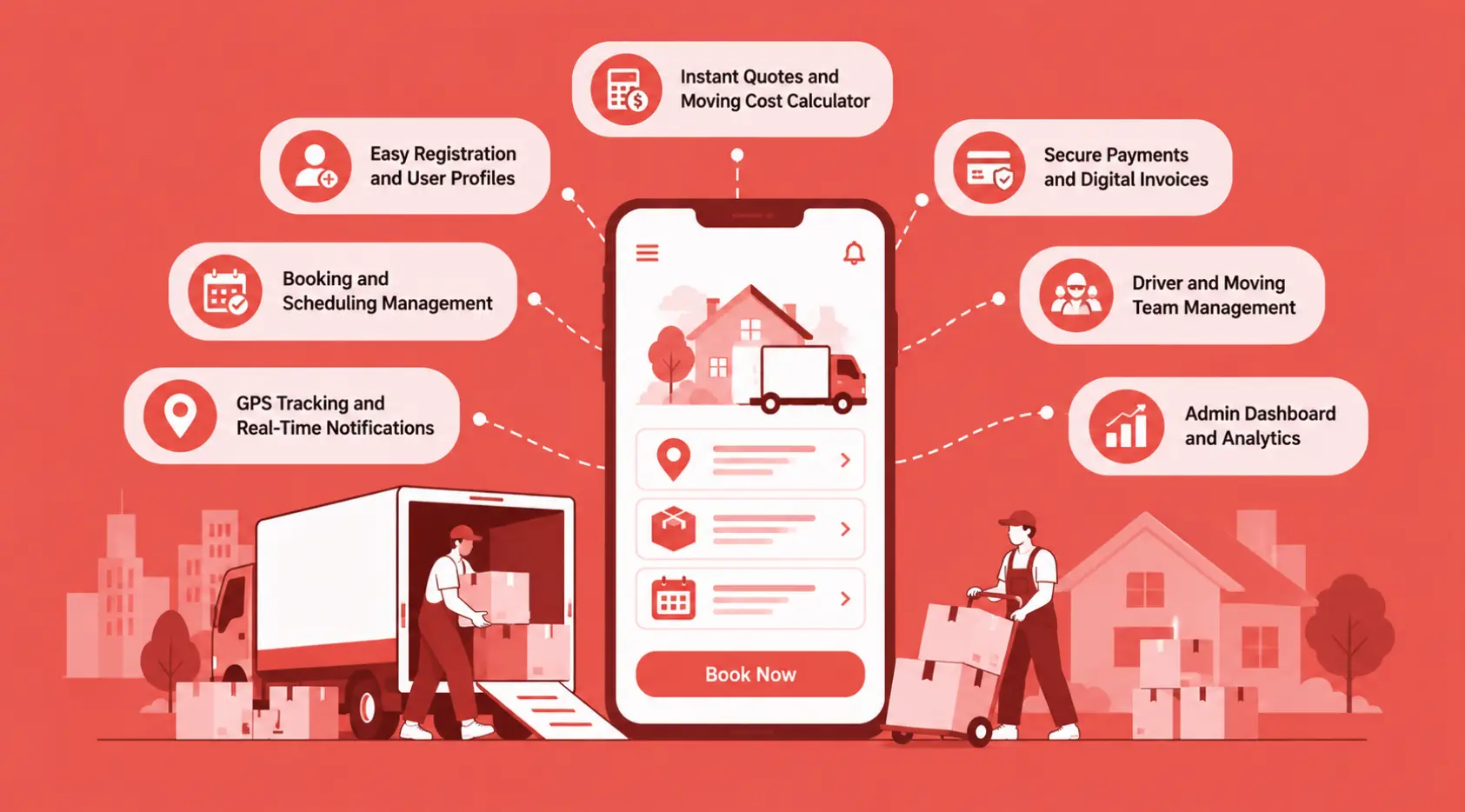
The features you choose should solve real operational problems rather than simply make the application look modern. A successful platform combines convenient booking, reliable logistics management, secure payments, and effective communication.
1. Easy Registration and User Profiles
Customers should be able to register using email, phone numbers, or supported social sign-in options. Their profiles can store saved addresses, previous bookings, preferred moving dates, and invoices.
This reduces repetitive data entry and makes repeat bookings easier.
2. Instant Quotes and Moving Cost Calculator
Pricing is one of the most important factors in relocation decisions. A cost calculator can estimate charges using:
- Pickup and destination addresses
- Distance between locations
- Number and type of belongings
- Property size and floor level
- Packing materials and labor requirements
- Vehicle type and additional services
For better accuracy, the system can combine customer inputs with inventory lists, photographs, or a virtual survey. Final quotations should clearly distinguish estimated prices from confirmed quotes, especially when access conditions or item quantities are uncertain.
3. Booking and Scheduling Management
Customers should be able to select a moving date, choose packing and transportation services, and confirm their booking. The platform should also prevent double bookings by checking vehicle and staff availability.
Automated reminders, rescheduling options, and cancellation policies help reduce missed appointments and scheduling conflicts.
4. GPS Tracking and Real-Time Notifications
Live tracking allows customers to monitor their shipment or moving vehicle during transportation. GPS integration can display the vehicle’s location and provide estimated arrival times.
Push notifications, SMS, or email alerts can communicate important milestones, including booking confirmation, team arrival, departure, delays, and successful delivery.
5. Secure Payments and Digital Invoices
Support for relevant payment methods allows customers to pay booking deposits or outstanding balances digitally. The app can generate invoices, record transactions, process eligible refunds, and maintain payment histories.
For businesses, a centralized payment dashboard also simplifies reconciliation and financial reporting.
6. Driver and Moving Team Management
The service-provider interface should include assigned jobs, navigation, customer contact details, inventory checklists, and job-status updates.
Delivery confirmation through digital signatures, photographs, or one-time passwords can help establish a clear record of completed work and reduce disputes.
7. Admin Dashboard and Analytics
The admin panel is the operational center of the platform. Administrators should be able to manage users, bookings, service areas, pricing rules, staff assignments, payments, complaints, and partner companies.
Reports covering booking conversion, average order value, cancellation rates, customer acquisition costs, and profit per move can help business owners make informed decisions.
For a more advanced platform, businesses can explore AI-powered app development to introduce intelligent quote recommendations, customer support automation, and demand forecasting where sufficient data is available.
Packers and Movers App Development Cost
The cost of developing a packers and movers app depends on the number of applications required, feature complexity, integrations, design requirements, and development team’s location and experience.
The following figures are indicative planning estimates in USD, not a fixed quotation from BinaryMetrix.
| Development level | Estimated cost | Typical scope |
| Basic MVP | 5,000–12,000 | Booking, profiles, basic quotes, admin panel |
| Mid-level platform | 12,000–30,000 | GPS tracking, payments, notifications, driver interface |
| Advanced marketplace | 30,000–60,000+ | Multi-vendor management, advanced dispatch, analytics, complex integrations |
What Influences the Development Budget?
Platform selection: Building separate native Android and iOS applications may require more investment than a cross-platform solution. Frameworks such as Flutter can help share code across platforms.
Feature complexity: Basic booking is simpler than automated dispatch, dynamic pricing, route optimization, or multi-vendor settlement.
Backend infrastructure: Real-time tracking, secure databases, APIs, and reliable notification systems require appropriate architecture.
UI/UX design: Clear booking flows and accessible interfaces improve usability and reduce customer confusion.
Maintenance and hosting: Cloud infrastructure, third-party API charges, security updates, bug fixes, and feature improvements create ongoing expenses.
A practical approach is to begin with a minimum viable product (MVP), validate demand in a limited service area, and expand features as booking volume and operational requirements grow.
Business Models for a Packers and Movers App
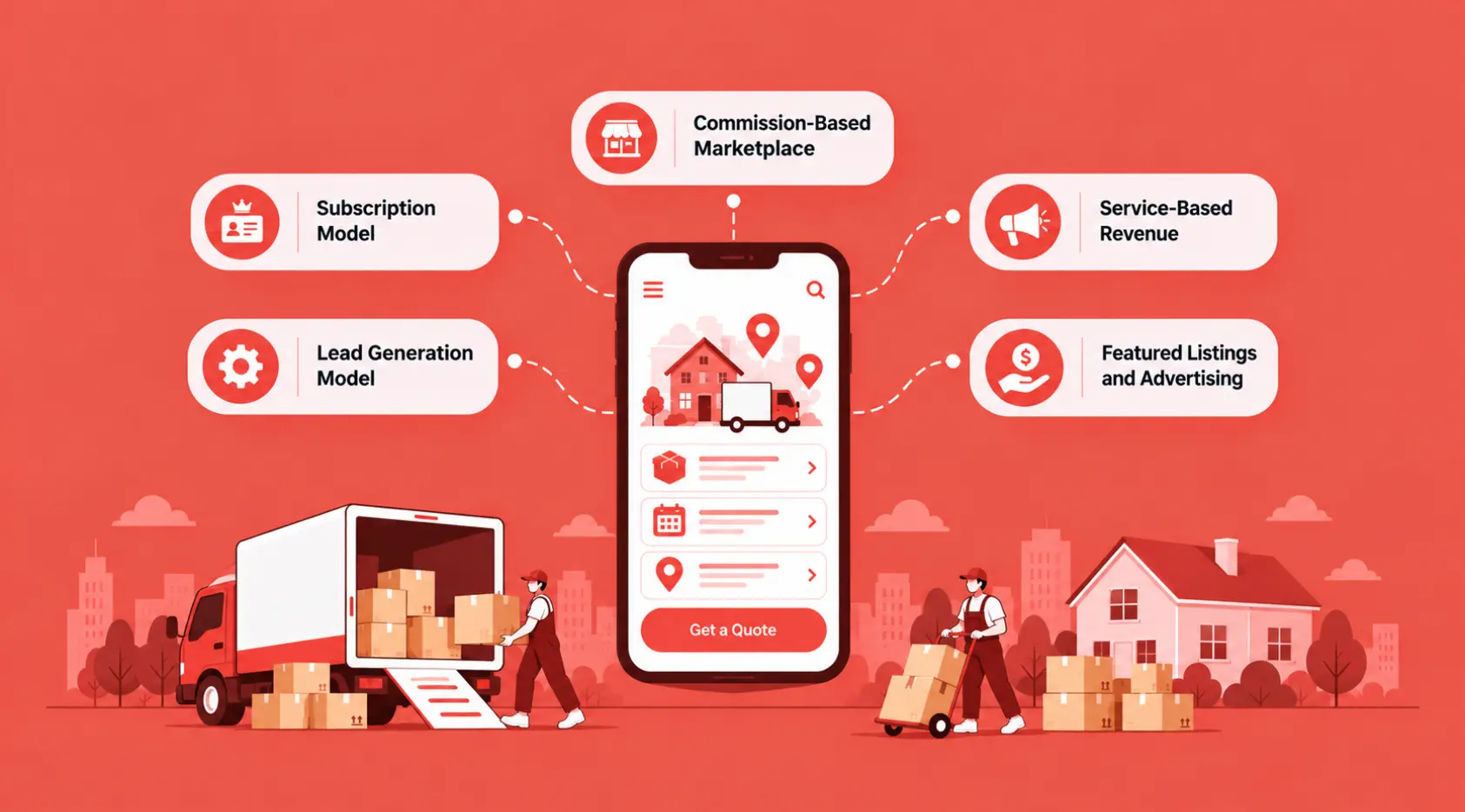
Choosing the right monetization strategy is just as important as selecting the right features. Your revenue model should align with your role in the relocation ecosystem.
1. Commission-Based Marketplace
The platform connects customers with independent moving companies and charges a commission on completed bookings.
For example, a platform charging a 12% commission on a $500 relocation earns $60 per completed booking before operating expenses.
This model works well when the business can attract customers and maintain a reliable network of service providers.
2. Subscription Model
Moving companies pay a monthly or annual fee to access the platform, manage bookings, receive leads, or use operational tools.
Subscription pricing creates more predictable revenue, particularly when vendors receive consistent value from the service.
3. Lead Generation Model
The platform generates relocation enquiries and sells qualified leads to registered moving companies. Businesses may pay per lead or purchase lead packages.
Clear rules are necessary to prevent duplicate lead sales, low-quality enquiries, and disputes about lead ownership.
4. Service-Based Revenue
Businesses can earn additional revenue through packing materials, furniture dismantling, storage, insurance arrangements through authorized partners, and specialized relocation services.
These add-ons can increase the average booking value without relying entirely on commission revenue.
5. Featured Listings and Advertising
Partner companies can pay for promoted placements within relevant search results. Such listings should be clearly identified as sponsored to preserve customer trust.
A marketplace may combine commissions, subscriptions, and featured listings rather than depend on a single revenue source.
Technology Stack and Development Approach
The technology stack should support the platform’s expected booking volume, real-time requirements, security needs, and future expansion.
A potential stack includes:
- Mobile applications: Flutter or React Native for cross-platform development, or native Android and iOS technologies.
- Backend: Node.js, Laravel, or another suitable server-side framework.
- Database: PostgreSQL or another database selected for the data model and workload.
- Maps and tracking: Mapping and geolocation APIs.
- Payments: A payment gateway appropriate for the target market.
- Infrastructure: Cloud hosting, monitoring, automated backups, and access controls.
The final selection should follow technical requirements rather than technology trends. You can review BinaryMetrix’s mobile app development services and full-stack app development capabilities to understand the available development approaches.
A structured process covering discovery, UI/UX design, development, testing, deployment, and maintenance also helps control scope and reduce avoidable rework.
How to Build a Successful Packers and Movers App
Start by identifying your target customers, service locations, and operating model. Decide whether you will manage your own relocation teams or connect customers with third-party providers.
Next, define the MVP, establish pricing rules, and map the complete booking journey. Develop the customer interface, operational dashboard, and essential service-provider functionality before introducing advanced automation.
Test the platform with real booking scenarios, including cancellations, payment failures, delivery delays, and changes in inventory. Once launched, measure booking conversion, repeat usage, customer satisfaction, and contribution margin.
Finally, invest in local SEO, relevant service pages, referral programs, and customer reviews to build demand. BinaryMetrix also offers search engine optimization services to support digital visibility alongside application development.
Conclusion
Packers and movers app development offers businesses an opportunity to transform a traditionally fragmented relocation process into a more organized, transparent, and scalable service. The right combination of booking management, accurate quotations, GPS tracking, digital payments, and operational analytics can improve customer experiences while reducing manual work.
However, long-term success depends on more than technology. A sustainable business model, reliable moving partners, transparent pricing, and consistent service quality are equally important.
If you are planning to launch a relocation platform, start with a clearly defined MVP, validate your business model, and build an architecture that can grow with demand.
Ready to build your packers and movers app? Connect with BinaryMetrix to discuss your requirements, feature priorities, technology options, and development budget.









 +91-7982030802
 +1(315) 585-1155