
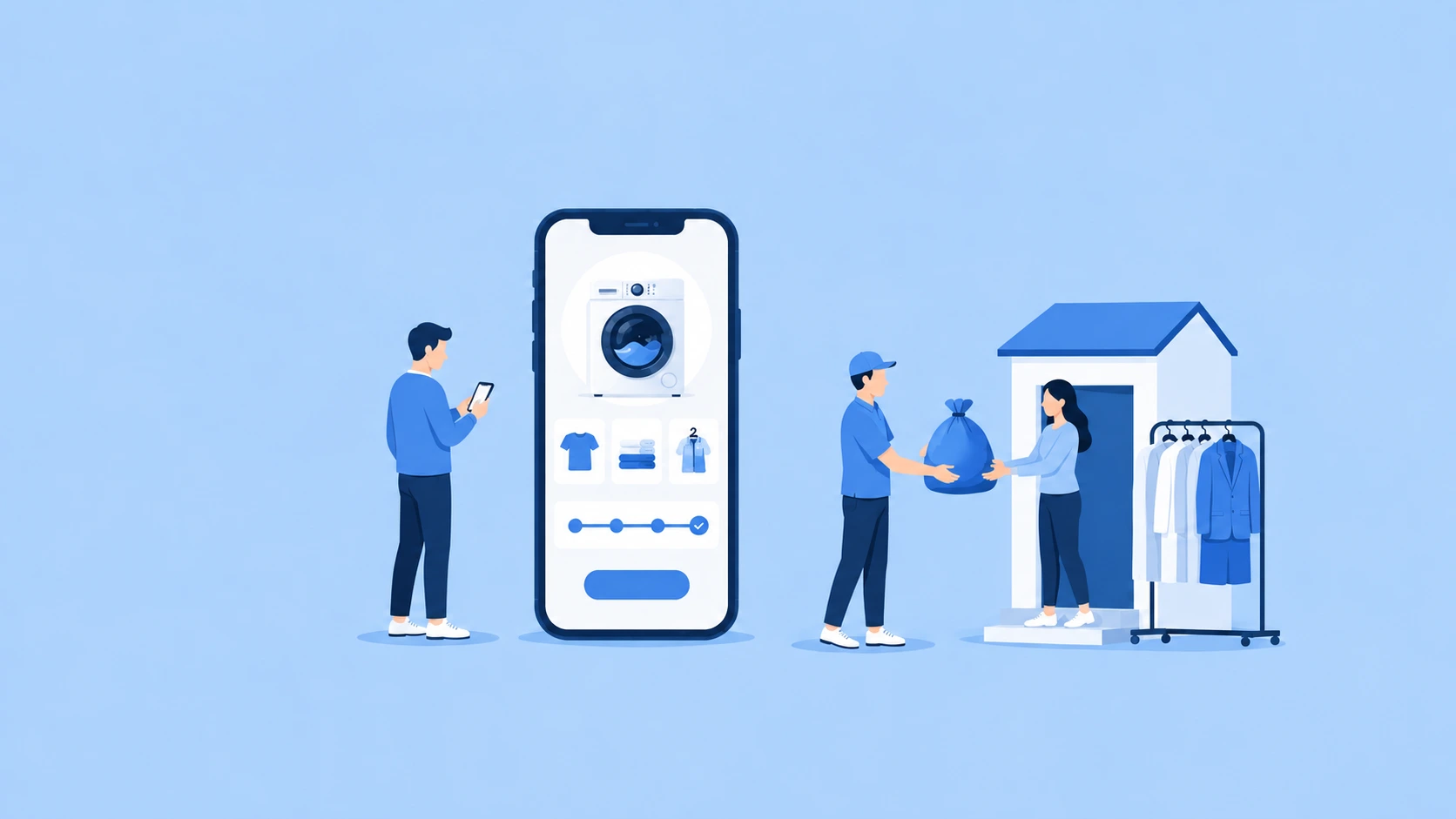
Nobody wakes up excited to sort whites from colors or drive across town to a dry cleaner before it closes at 6 PM. That’s exactly why on-demand laundry services have found solid footing in cities across the US, backed by software that quietly handles pickups, routing, order tracking, and payments without anyone standing at a counter.
If you’re a startup founder, a laundromat owner looking to modernize, or an entrepreneur eyeing this space, laundry app development is probably the single biggest decision standing between your idea and a working business. This guide walks through what actually goes into building one, what it should cost, and how to avoid the mistakes that sink a lot of first-time app projects.
Why On-Demand Laundry Apps Are Gaining Ground
The laundry and dry cleaning industry hasn’t changed much in decades, but customer expectations have. People want to book a pickup the same way they book a ride or order dinner: a few taps, a confirmed time window, and a notification when it’s done. Busy professionals, parents juggling schedules, and college students without access to a washer make up the core audience, and they’re increasingly willing to pay a premium for the convenience.
For business owners, an app also solves a real operational problem. Phone-based booking is slow, error-prone, and hard to scale. A well-built app centralizes orders, gives drivers optimized routes, and gives owners visibility into what’s happening across every pickup and delivery in real time. That combination of better customer experience and tighter operations is why so many service-based startups are approaching agencies about this space today.
Let's talk through your idea before you spend on development. We'll help you figure out exactly what features you need.
Book a Free ConsultationWhat Is Laundry App Development, Really?
At its core, this means building a connected system, not just a single app. A functioning platform usually has three parts working together:
- A customer-facing app for scheduling pickups, choosing services, and tracking orders
- A driver or staff app for managing routes, updates, and proof of delivery
- An admin panel where the business owner manages orders, staff, pricing, and reports
Some businesses only need the customer app plus a basic admin dashboard, especially if pickups are handled by existing staff. Others, particularly multi-location operators, need the full three-sided system. Getting this scope right at the start saves a lot of budget later, because adding a driver app after launch usually means rebuilding parts of the backend rather than bolting something on.
Core Features Your Laundry App Needs
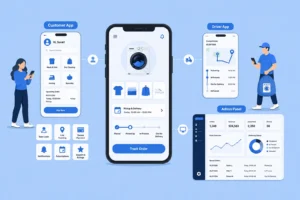
A laundry app development project tends to succeed or fail based on how well the feature list matches actual customer behavior, not how many features it has. Here’s what tends to matter most.
Customer App Features
- Simple onboarding with phone or social sign-in, no long forms
- Service selection covering wash and fold, dry cleaning, ironing, and specialty items like shoes or curtains
- Scheduled pickup and delivery with clear time slots rather than vague “morning” or “afternoon” windows
- Live order tracking so customers know exactly where their laundry is in the process
- In-app payments supporting cards, digital wallets, and saved payment methods
- Push notifications for pickup confirmations, order status changes, and delivery alerts
- Subscription plans for repeat customers who want weekly or biweekly service at a discount
- Ratings and support so customers can flag issues or rate drivers directly
Delivery Partner or Driver App Features
- Route optimization so drivers aren’t zigzagging across a city
- Order details including item counts, special instructions, and customer notes
- Status updates the customer sees instantly, from “picked up” to “processing” to “out for delivery”
- Digital proof of delivery, whether that’s a signature or a photo
Admin Panel Features
- Centralized order management across all active jobs
- Staff and driver assignment tools
- Pricing and promo code controls
- Reporting on revenue, order volume, and customer retention
- Inventory tracking if the business also sells detergents or accessories
None of this needs to be built from scratch every time. A capable mobile app development partner will usually have reusable modules for scheduling, payments, and notifications that speed up delivery without sacrificing quality.
Plug in skilled developers fast, with no long onboarding delays.
Hire Developers NowDry Cleaning App Development: What’s Different
Dry cleaning app development shares most of its DNA with the wash-and-fold model, but a few things change. Dry cleaning customers tend to care more about item-level tracking, since a suit or a wedding dress isn’t something you want lumped in with a bag of shirts. That means your app needs per-item tagging, condition notes before and after cleaning, and often a longer turnaround window that the app has to communicate clearly.
Pricing is also more variable. Wash and fold is usually priced per pound, but dry cleaning is priced per garment, and garment types multiply fast. The pricing engine needs to handle that complexity without turning checkout into a spreadsheet. Getting this right separates a generic booking app from genuine on-demand dry cleaning app software.
A Real-World Scenario
Picture a laundromat owner in a mid-sized US city who’s been running two locations for years, taking orders over the phone and dispatching a single delivery van manually with a paper log. Growth has stalled because there’s a ceiling on how many calls one person can juggle in a morning.
After moving to an app-based system, the same business can accept orders 24/7 instead of only during business hours. Customers schedule pickups themselves, the driver app assigns the nearest available route automatically, and the owner can see same-day revenue from a phone instead of waiting for the paper log to get tallied at closing. Within a few months, order volume per driver typically climbs because routes are tighter and fewer pickups get missed due to scheduling mix-ups. That’s the practical value here: not just a nicer interface, but fewer manual bottlenecks holding the business back.
On-Demand Laundry App Development Cost
This is usually the first question founders ask, and the honest answer is that it depends heavily on scope. Cost is shaped by a handful of variables:
- Number of apps needed (customer only, versus customer plus driver plus admin)
- Platform coverage (iOS only, Android only, or both)
- Feature complexity, especially around routing, subscriptions, and payment integrations
- Design work, including custom UI versus a template-based approach
- Third-party integrations like payment gateways, SMS providers, and mapping APIs
A basic MVP with a customer app and simple admin dashboard sits at the lower end of the range. A full three-sided platform with route optimization, subscription billing, and multi-location support costs considerably more. Businesses researching on-demand laundry app development cost and features side by side usually find that trimming the feature list for launch, then expanding once real usage data comes in, is the more capital-efficient path.
Get a clear, itemized cost estimate within 24 hours, no guesswork involved.
Get a Free QuoteHow to Choose a Laundry App Development Company
Not every development shop is equally suited to this kind of project. A few things worth checking before signing anything:
- Relevant portfolio: Ask to see prior on-demand or logistics-style apps, not just generic mobile projects. Reviewing a portfolio of similar work tells you more than a sales pitch ever will.
- Backend and scaling experience: Order management, real-time tracking, and route logic require solid backend architecture, not just a pretty front end.
- Post-launch support: Laundry apps need ongoing maintenance as payment providers update APIs and app store requirements shift.
- Transparent pricing: A reputable laundry app development company in the USA or elsewhere should be able to break down cost by feature and platform, not just hand over a single lump number.
For startups specifically, it’s worth asking how the company handles phased builds. The best laundry app development company for startups will usually push back on an oversized feature list and suggest a leaner first version instead of locking in a huge scope that never gets fully used.
Tech Stack Considerations
Most laundry apps today are built using cross-platform frameworks to cover both iOS and Android without doubling the effort. Flutter and React Native are the two most common choices, and both handle real-time tracking, push notifications, and payment integrations without issue. If the business needs deep platform-specific performance, such as advanced background location tracking for driver apps, native app development is sometimes worth the extra cost, though for most laundry pickup and delivery app development projects, cross-platform tooling gets the job done at a fraction of the price.
On the backend, scalable cloud infrastructure matters more than any single framework choice. Order tracking, driver location updates, and payment processing all need to stay responsive as volume grows, especially during peak hours like weekend mornings when pickup requests spike.
Common Mistakes to Avoid
- Skipping the driver app: Managing delivery through spreadsheets or group chats quickly breaks down once daily pickups grow past a handful.
- Overbuilding the MVP: Launching with subscriptions, loyalty points, and multi-location support all at once delays launch and inflates cost without proven demand.
- Confusing pricing screens: Unclear per-item or per-pound pricing is one of the fastest ways to lose a customer mid-checkout.
- Underestimating support needs: Laundry apps involve payments and physical goods, so in-app customer support isn’t optional.
- Choosing a generic template over thoughtful UI: A rushed, cluttered interface undercuts trust, especially for dry cleaning customers handing over expensive garments.
Working with a team experienced in web app development alongside mobile can also help, since many laundry businesses eventually want a browser-based admin dashboard that staff can access from any device without installing anything.
Final Thoughts
Laundry app development isn’t just about shipping an app to app stores. It’s about rebuilding how a service business takes orders, manages logistics, and keeps customers coming back without friction. The businesses that get the most value out of this shift start with a focused feature set, choose a partner who understands logistics-style apps specifically, and treat launch as the beginning of an ongoing product, not a one-time project.
If you’re weighing your options, it often helps to talk through the scope with a team that’s built similar platforms before committing to a full build. You can also hire developers on a flexible basis if you already have part of the product defined and just need execution support, or reach out directly through contact us for a free consultation on scope and cost.
Get a second opinion on your scope and budget before you sign with anyone.
Talk to Our Team





 +91-7982030802
  +1(315) 585-1155