
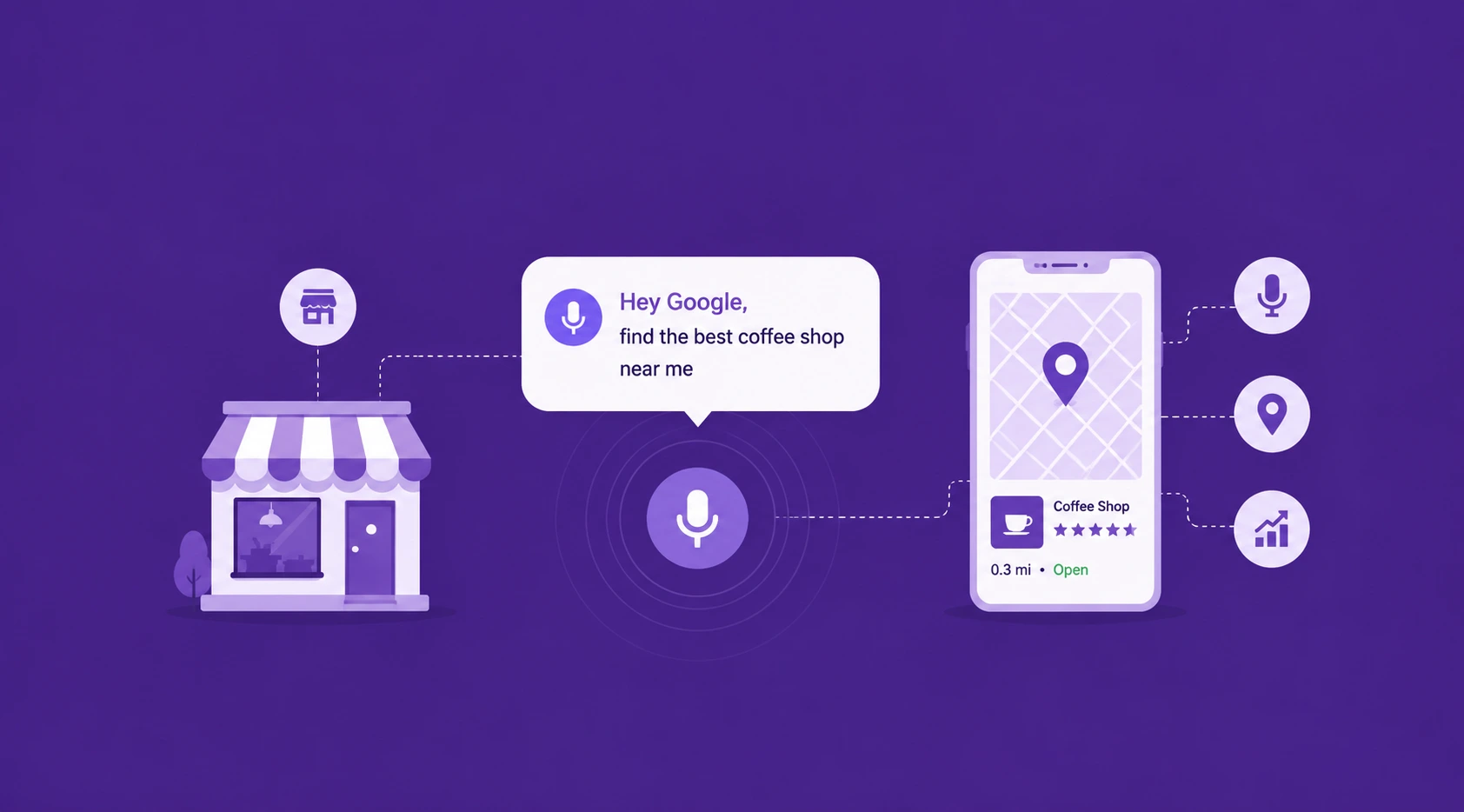
Haven’t put much thought into voice search optimization yet? You’re not alone. People ask their phones, their smart speakers, even their cars to find a plumber, a pizza place, a dentist nearby. Every day. And the businesses that show up in those spoken answers? Usually the ones that bothered to prepare ahead of time.
So what does that prep actually look like. This guide walks through what it involves, why it matters for local visibility heading into 2026, and the concrete steps that get your business heard, not just seen on a results page.
What Voice Search Optimization Means for Local Businesses
At its core, it’s the practice of shaping your website, listings, and content so voice assistants like Google Assistant, Siri, and Alexa can find your business, understand what you offer, and read that information out loud when someone asks. Overlaps with regular SEO, sure. But the intent behind a spoken query is different. Someone typing “best coffee shop” isn’t doing the same thing as someone asking their phone, “where’s a good coffee shop near me right now.” Voice queries run longer. They sound more like conversation. And they’re loaded with local context, because nobody’s asking a smart speaker about a business three states away.
None of this is a project you knock out once and forget. Voice search optimization touches your Google Business Profile, your site speed, how your content is structured, whether you’re actually answering the questions customers ask out loud. Get those pieces right and there’s a real shot at being the answer an assistant gives when someone nearby needs exactly what you sell.
Why Voice Search SEO Matters for Local Businesses in 2026
Voice search SEO stopped being a nice-to-have a while back. Edison Research’s Infinite Dial study has tracked US smart speaker ownership hovering around a third of Americans aged 12 and up for several years running now, roughly 100 million people with a device sitting on the kitchen counter, ready to field a question at any hour. Add in smartphone voice search, in-car assistants, wearables, and the real number of people using voice search in some form is a lot bigger than the smart speaker figure alone suggests.
Here’s what matters even more for a local business: intent. A big share of voice queries carry that local, “near me” flavor. Makes sense, people reach for voice search when they’re driving, cooking, or just don’t want to type. If your business isn’t set up to answer those questions clearly, a competitor down the street probably already is.
Get a free audit of your Google Business Profile, site speed, and local listings to see exactly where you stand.
Get My Free AuditHow Does Voice Search Affect Local SEO
A few concrete ways. It rewards businesses with complete, accurate, consistent listings across the web, since assistants tend to pull answers from structured sources like your Google Business Profile rather than crawling a page start to finish. It favors content written the way people actually talk, full sentences and direct answers over fragmented keyword phrases jammed into a paragraph. And it puts extra weight on page speed and mobile usability, because a slow site is a poor fit for an assistant trying to pull a quick answer.
voice search doesn’t replace local SEO. It just raises the bar for how clean that local SEO needs to be.
Voice Search Ranking Factors You Should Know
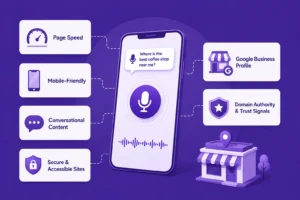
Been searching for how to rank for voice search results? Honest answer: there’s no separate algorithm just for voice. Assistants lean on a mix of signals that already influence regular rankings, weighted a little differently. A few factors that consistently show up:
- Page speed: Assistants pull answers from pages that load fast. A sluggish response defeats the whole point of asking out loud.
- Mobile-friendliness: Most voice queries start on a phone. A site that renders poorly on mobile is already behind.
- Structured, conversational content: Pages that answer specific questions in plain language get pulled into featured snippets and voice answers more often.
- Google Business Profile completeness: Accurate hours, categories, service areas, photos, all of it helps assistants match your business to local intent.
- Domain authority and trust signals: Reviews, citations, backlinks, they factor into whether a source gets treated as credible enough to read aloud.
- Secure, accessible sites: HTTPS and clean site architecture. Baseline, not optional.
Already working with an agency on SEO services? You’re probably closer to voice-ready than you think. Most of what’s left comes down to content format and keeping your local data accurate.
Our local SEO team builds the technical foundation voice assistants actually trust and read aloud.
Talk to Our SEO TeamHow to Optimize Your Website for Voice Search
This is where the actual work happens. If you’re wondering how to optimize your website for voice search, start here.
Write Conversational, Question-Based Content
Think about how customers actually phrase questions out loud, then build content around those exact phrases. A plumbing company might add a short section answering “how much does it cost to fix a leaking pipe,” written in plain, direct language. Keep the answer close to the question. Ideally within the first sentence or two, since assistants often read only the opening portion before moving on.
Claim and Optimize Your Google Business Profile
Local SEO voice search results lean hard on your Google Business Profile. Fill in every field you can: categories, service areas, business hours, attributes, photos. Keep your name, address, and phone number identical across your website and every directory you’re listed on. Inconsistent listings confuse search engines just as much as they confuse the people trying to find you.
Speed Up Your Site
A page that takes six seconds to load isn’t getting read aloud by an assistant hunting for a fast answer. Simple as that. If your site’s been dragging, it’s worth working through the steps to speed up your website before touching anything else on this list.
Add Local Schema Markup
Structured data helps search engines understand exactly what your business is, where it operates, what it offers, which makes it easier for voice assistants to pull accurate answers. Deep enough topic on its own that we’re planning a dedicated local schema markup guide down the road.
Build a Base of Local Trust Signals
Consistent reviews, local citations, and steady link building all feed into the kind of authority that voice assistants and search engines both respect. Haven’t looked into backlink strategies in a while? Worth revisiting. Fresh, relevant links still move the needle more than most people expect.
Book a quick call and we'll map out a voice search strategy built around your business and your market.
Book a Free CallHow to Optimize a Website for Siri and Alexa Search
Siri leans heavily on Apple Maps data and Yelp for local results, so keeping your Apple Business Connect listing and Yelp profile accurate matters just as much as your Google presence does. Alexa is worth watching closely right now too. Amazon rolled Alexa+, its newer generative AI assistant, out to all US customers in February 2026, and it pulls from a broader mix of local data sources than the old Alexa did, alongside Bing. A clean Bing Places listing shouldn’t be an afterthought either.
Across both platforms, the fundamentals don’t really change: accurate business information, fast-loading pages, content that answers questions directly. Neither assistant can read aloud what it can’t find or trust in the first place.
Google Assistant SEO: Getting Found by Smart Speakers
Worth knowing before you invest heavily here: Google has been actively retiring Google Assistant in favor of Gemini throughout 2025 and into 2026, with the cutover timeline shifting more than once as Google works out the kinks. Practically speaking, that means Google Assistant SEO today is really about optimizing for however Google’s voice layer works at the moment, currently a mix of legacy Assistant and Gemini depending on the device. The underlying mechanics stay familiar. Gemini and Assistant both lean on Google Search and the Knowledge Graph for factual answers, so landing in position zero, the featured snippet, still gives you a meaningfully better shot at being read aloud. Strong Google Business Profile signals and a healthy volume of reviews matter just as much as before. Worth treating this as an area to check in on every few months rather than a one-and-done setup, given how much is still in motion.
How to Get a Featured Snippet for Voice Search
Featured snippets remain one of the clearest paths into voice answers, since assistants frequently read that content aloud, close to word for word. A few things that help:
- Answer a specific question in one to two concise sentences near the top of the page.
- Use clear headings that mirror how people actually phrase questions.
- Add a short bulleted list or numbered steps when the content fits a how-to format.
- Keep the answer accurate and current. Outdated snippets get swapped out fast.
None of this guarantees a snippet. But pages built this way consistently perform better in both text and voice results, and that counts for something.
A Real-World Example: A Local Bakery Wins Voice Search Traffic
Picture a small neighborhood bakery that rewrote its “About” and FAQ pages to directly answer questions like “is there a bakery near me open right now” and “does this bakery make gluten-free bread.” The owner also cleaned up the Google Business Profile, added accurate hours, uploaded fresh photos, made sure the site actually loaded fast on mobile. A few months later, foot traffic from customers mentioning they’d found the place through a voice search on their phone went up noticeably. Nothing fancy about the approach. It just matched the content to how real customers ask questions out loud.
Voice Search Statistics 2026: What the Data Shows
Voice search statistics 2026 research paints a fairly consistent picture, even with the platform shakeups underway. Smart speaker ownership in the US has plateaued near a third of the population for a few years running, while smartphone-based voice search keeps climbing as recognition accuracy improves. A large share of voice queries, often cited around three-quarters by industry researchers, carry local or “near me” intent. That local skew is exactly why this channel matters so much for small and mid-sized businesses, not just national brands with the ad budgets to match.
Common Mistakes That Hurt Voice Search Optimization
A handful of habits quietly undermine these efforts, even on a site that looks solid at first glance.
- Leaving Google Business Profile fields incomplete or outdated.
- Writing content stuffed with keywords instead of natural questions and answers.
- Ignoring page speed on mobile devices.
- Letting business name, address, and phone details drift out of sync across directories.
- Treating voice search as a one-time project instead of ongoing maintenance.
Fixing these doesn’t require a full website rebuild. Mostly just requires consistency, and checking in as platforms like Google Assistant and Alexa keep changing under the hood.
Final Thoughts
Voice search optimization isn’t a passing trend for local businesses, not anymore. It’s a practical response to how people already search, especially when they’re local, in a hurry, or would rather talk than type. Start with your Google Business Profile, tighten up site speed, write content that answers real questions in plain language, and build the kind of local trust signals that both customers and search engines respect. Want help putting a full strategy together? Our team can walk you through a tailored digital marketing strategy or a focused set of SEO packages built around local visibility. Get in touch and we’ll take it from there.
The businesses answering customer questions today are the ones showing up tomorrow. Let's fix that gap.
Start Winning Local Search







 +91-7982030802
  +1(315) 585-1155