
Honestly, most business owners think about their website the way they think about their car – they know something feels off, but they keep putting off the visit to the mechanic. The homepage looks a little tired, a form stopped working six months ago, and mobile users are bouncing like crazy. Still, the question that actually stops people is money. How much does this cost? And is right now even the right time to do it?
Those are fair questions, and this guide is going to give you real answers. We will walk through website redesign cost in plain terms, explain what actually drives pricing up or down, and help you figure out whether your situation calls for a quick refresh or a complete rebuild.
Our team helps businesses across the US plan smarter website redesigns from day one. No guesswork, just clear direction.
Get a Free ConsultationWhat Does a Website Redesign Actually Cost?
Here is the honest answer: it depends, and anyone who gives you a firm number before knowing your project is probably guessing.
That said, website redesign cost in the US generally falls into predictable ranges based on project scope. Here is how most projects actually shake out:
| Project Type | Estimated Cost Range |
| Basic business website refresh | $500 – $1,500 |
| Mid-size business redesign | $1,500 – $2,500 |
| E-commerce website redesign | $1,650 – $5,000+ |
| Custom web application rebuild | $5,000 – $10,000+ |
These figures are realistic starting points, not guarantees. What you end up paying will come down to your site’s current condition, how big the changes actually are, and the caliber of web development team you bring on.
The factors that push costs up most reliably are:
- Page count and how much content needs to be rebuilt or migrated
- Custom functionality requirements versus using ready-made templates or plugins
- Third-party integrations like CRMs, payment processors, or booking systems
- Whether the visual identity itself needs rethinking or just updating
- How much SEO groundwork needs to be laid before and after launch
- What kind of support arrangement you need once the site goes live
A solo freelancer might knock out a clean five-page WordPress site for $500. A professional website redesign agency handling a 50-page e-commerce build with multiple API connections is going to price that very differently, and for good reason. The accountability, technical depth, and execution consistency simply are not the same.
Signs Your Website Needs a Redesign
Before spending a dollar, you need to be honest with yourself about what your site is actually doing. Not what you hope it is doing. What it is actually doing.
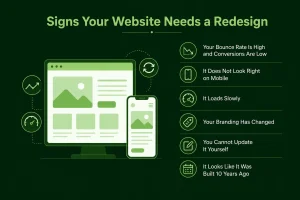
Your Bounce Rate Is High and Conversions Are Low
People arrive, take one look, and leave. That pattern usually means something about the experience is off, whether that is the layout, the load time, the messaging, or all three. A site that is genuinely well designed does not drive people away the moment they show up.
It Does Not Look Right on Mobile
More than 60% of web traffic today comes from phones. If your site squishes awkwardly, forces people to pinch-zoom, or hides important buttons behind clutter on small screens, that is not a minor inconvenience. It is a conversion killer. Mobile responsiveness stopped being optional a long time ago.
It Loads Slowly
Load time affects your rankings and your user experience at the same time. Three seconds is roughly the ceiling before most visitors give up and go somewhere else. A redesign often gets at performance problems that patching alone never fully solves.
Your Branding Has Changed
Maybe the company pivoted, the logo got updated, or you are going after a different kind of customer than you were two years ago. A site that does not match who your business actually is right now creates a quiet but real credibility problem.
You Cannot Update It Yourself
If making a simple edit, swapping out a banner image, updating your hours, fixing a typo, requires a developer every single time, that is a workflow problem the redesign should fix. You should not need technical skills to run your own website.
It Looks Like It Was Built 10 Years Ago
Design ages faster than most people expect. What looked sharp in 2016 looks stale today, and visitors notice. They may not say it out loud, but they absolutely factor it into whether they trust you enough to reach out.
We audit websites daily and the results are eye-opening. Let us take a look at yours and tell you exactly what needs fixing.
Book a Free Website AuditWebsite Redesign vs Rebuild: What Is the Difference?
This trips people up more than almost any other question in the process, so let me break it down clearly.
A redesign works on the surface layer. New visuals, cleaner layout, better user experience, maybe some structural changes to navigation or content flow. The platform underneath, WordPress, Shopify, whatever it is, stays.
A rebuild is starting over. New platform, new codebase, new architecture. Everything gets reconsidered from the ground up. It takes longer, costs more, and is genuinely the right call only in certain situations.
Those situations include:
- The current platform is outdated and no longer properly supported
- You need to shift from a static site to something that handles real user interactions or transactions
- Your feature requirements have outgrown what the existing setup can realistically handle
- The technical debt has piled up to the point where fixing it costs more than just building clean
Most mid-size business projects land in the redesign category. If you are unsure which yours actually needs, an honest conversation with a professional website design team will usually make that clear fast. It should not be a guessing game.
The Website Redesign Process: What to Expect
Knowing the stages ahead of time saves a lot of frustration. Here is how a professional website redesign process typically unfolds.
Discovery and planning is where the real work starts, before anyone touches a design tool. Goals get clarified, the audience gets defined, and the technical requirements get mapped out. Skip this phase and you will pay for it later.
UI/UX design is where the experience takes shape visually. Wireframes come first, then mockups. The thinking behind layout, user flow, and brand alignment all happens here. Getting this right upfront is why working with proper UI/UX services matters so much. It is far cheaper to adjust a wireframe than to rewrite coded pages.
Development builds out what was designed. Front end is what users interact with. Back end is the infrastructure running behind it: databases, APIs, server logic. Timeline at this stage depends almost entirely on how complex the features are.
SEO migration is where many redesigns quietly go wrong. Changing your URL structure, reorganizing content, or moving platforms without a proper plan can devastate rankings that took years to earn. This deserves its own section, which comes next.
Testing and quality assurance means checking everything before it goes live. Not just visually. Browser compatibility, form submissions, load performance, mobile behavior, all of it.
Deployment and post-launch support marks the go-live and the beginning of the maintenance phase. Ongoing website maintenance after launch is what protects the investment you just made.
SEO and Website Redesign: Protecting Your Rankings

I want to be direct about this: a careless redesign can wreck your organic search performance. Fast. Rankings that took two or three years to build can drop in weeks if the SEO side of a migration is handled poorly.
SEO for website redesign is not something you address after the new site is live. It starts during planning. The critical things to protect are your URL structure, your indexed content, your existing metadata, and your internal linking patterns.
A solid website redesign SEO checklist covers:
- Full crawl of the existing site to document every URL currently indexed
- Redirect mapping for any URLs that will change (301s, not 302s)
- Carrying over existing title tags and meta descriptions rather than starting blank
- Maintaining or improving heading hierarchy and keyword placement across pages
- Preserving internal links between related pages so link equity does not evaporate
- Running a fresh crawl immediately post-launch to catch broken links or missing redirects before Google does
The whole point is to come out of the redesign ranking at least as well as you went in, ideally better. That only happens reliably when a team doing SEO expertise is involved from the start, not brought in to clean up afterward.
How to Choose the Right Website Redesign Company
The agency you pick matters more than your budget, your timeline, or almost anything else. A great team can work within constraints. A bad one will create problems no amount of money fixes quickly.
A good website redesign services provider leads with questions about your business, not your color preferences. They want to know what the site needs to accomplish, who it is for, and what success actually looks like for you. If the first conversation is mostly about aesthetics, that is a warning sign.
What to actually look for:
- Portfolio work at a complexity level comparable to your project
- Design and development handled internally, not subcontracted out to strangers
- SEO baked into the process from the beginning, not added as an afterthought
- Clear milestones and communication checkpoints throughout the project
- Post-launch support that is defined in the contract, not promised vaguely
Case studies carry more weight than portfolio screenshots. Screenshots show taste. Case studies show results.
Website Redesign Pricing Models Explained
Most agencies price their work one of three ways, and understanding the difference matters before you start comparing quotes.
Fixed price gives you a defined scope at a set number. Works well when the project is clearly defined going in. Where it gets tricky is scope creep: if your requirements expand mid-project and the agreement is vague, you will either pay more or get less.
Hourly rate is more flexible, but budgeting for it is genuinely harder. US-based development agencies typically run $75 to $200+ per hour depending on their specialization and how senior the people on your project actually are.
Retainer or phased engagement spreads cost across time and is common for larger, more complex projects. It also works well for businesses that want ongoing support beyond launch, including teams managing SEO link building and digital marketing as part of a longer growth strategy.
Whichever model fits your situation, get the deliverables documented in writing before anything starts. Most web project disappointments trace back to scope that was assumed rather than agreed on.
When Should You Rebuild Your Website?
Put simply: when staying put costs more than moving forward.
That tipping point looks different for every business, but some situations make it pretty clear. Take the redesign or rebuild conversation seriously if:
- The site has not had meaningful updates in three or more years
- Traffic or lead volume has been slipping without an obvious marketing explanation
- You hesitate before sharing your URL in a sales conversation or a proposal
- A direct competitor just launched something noticeably sharper than what you have
- Your business has grown or shifted in a direction the current site cannot honestly represent
None of those are small things. A website that is quietly working against you is a real cost, even if it does not show up as a line item. The website redesign cost is a real investment too, but at some point the math flips, and waiting stops being the cautious choice.
Whether you need a quick refresh or a complete rebuild, our team delivers websites that actually perform and convert.
Start Your Redesign Today







 +91-7982030802
  +1(315) 585-1155