

The transportation and logistics industry has become increasingly dependent on digital technology. Businesses are no longer competing only on delivery speed, transportation capacity, or service coverage. Customers also expect shipment visibility, accurate delivery updates, easy booking, and transparent communication throughout the transportation process.
Traditional logistics operations often rely on phone calls, spreadsheets, emails, and disconnected management systems. These methods can create communication gaps, shipment delays, and difficulties in managing multiple transportation activities. A professionally developed logistics website can bring these operations together through a centralized digital platform.
For transportation companies, freight operators, courier businesses, and third-party logistics providers, logistics website development is an opportunity to improve operational efficiency, strengthen customer relationships, and establish a stronger digital presence.
However, a modern logistics website should do more than display company information and contact details. It should support essential business activities such as shipment booking, tracking, quotation requests, customer account management, and communication.
In this guide, we explore the essential features, development considerations, technology options, and practical steps involved in building a logistics website for modern transportation companies.
What Is Logistics Website Development?
Logistics website development involves designing and building a digital platform that helps transportation and supply chain businesses manage their online presence and customer-facing operations.
Depending on business requirements, the website can function as a corporate information platform, a shipment booking portal, or a comprehensive logistics management system.
A typical logistics website may support:
- Shipment booking and service requests.
- Real-time shipment tracking.
- Freight quotation requests.
- Customer registration and account management.
- Transportation service management.
- Delivery notifications and communication.
- Administrative reporting and shipment management.
For example, a freight forwarding company may need an online quotation system, while a courier business may prioritize shipment tracking and delivery status updates.
The website’s structure should reflect the company’s actual operations rather than rely on a generic template.
Why Do Transportation Companies Need a Modern Logistics Website?

A strong digital platform can improve several aspects of logistics operations.
Better customer experience: Customers can access shipment information, request services, and receive updates without repeatedly contacting support teams.
Operational visibility: Centralized information helps businesses monitor shipments, service requests, and delivery progress.
Improved business credibility: A professional website communicates service capabilities, operating locations, industry experience, and contact information.
Simplified communication: Automated notifications and customer portals reduce repetitive enquiries and information gaps.
Business expansion: A well-structured website allows companies to introduce additional services, serve new locations, and generate enquiries through digital channels.
For transportation businesses handling multiple customers and shipments, these improvements can make everyday operations more organized and predictable.
Essential Features of a Logistics Website
The most valuable features depend on the transportation services offered, but several functionalities form the foundation of an effective logistics platform.
1. Shipment Booking and Request Management
A shipment booking system allows customers to submit transportation requests directly through the website.
The booking form can collect essential information, including:
- Pickup and delivery locations.
- Shipment type and dimensions.
- Package weight and quantity.
- Preferred transportation method.
- Pickup date and delivery requirements.
Once submitted, the request should appear in the administrative dashboard, where staff can review the details, confirm availability, and coordinate the next steps.
A well-designed booking workflow reduces manual data entry and makes shipment requests easier to manage.
2. Real-Time Shipment Tracking
Shipment tracking is one of the most important features of a modern logistics website. Customers want to know where their packages are and whether deliveries are progressing as expected.
GPS integration can help businesses display vehicle locations and movement on an interactive map. For parcel-based logistics, tracking can also use barcode or QR code scans at different operational checkpoints.
Useful tracking information includes:
- Shipment confirmation.
- Pickup completed.
- In transit.
- Arrived at a distribution facility.
- Out for delivery.
- Successfully delivered.
The tracking interface should clearly display the latest available status and its timestamp. Businesses should avoid presenting estimated delivery information as a guaranteed arrival time.
3. Freight Quotation and Rate Calculator
Transportation companies often receive enquiries involving different shipment sizes, destinations, delivery schedules, and transportation requirements.
An online quotation system allows customers to submit shipment details and receive an estimate or request a customized quotation.
Depending on the business model, calculations may consider distance, shipment weight, dimensions, vehicle requirements, delivery urgency, and additional handling services.
For complex freight operations, a request-based quotation workflow may be more appropriate than displaying automated rates.
4. Customer Dashboard and Shipment History
A dedicated customer dashboard provides access to important shipment information from one location.
Customers should be able to view active shipments, previous deliveries, booking details, invoices, and tracking updates.
For businesses handling recurring shipments, saved addresses and reusable shipment information can simplify future bookings.
Account-based access also helps companies maintain organized communication with individual customers and business clients.
5. Automated Notifications and Alerts
Customers should not need to repeatedly check the website for shipment updates.
Email, SMS, and push notifications can communicate important events, including booking confirmation, pickup completion, transit updates, delivery delays, and successful delivery.
Businesses can also use automated alerts to notify internal teams when shipments require attention.
6. Admin Dashboard and Logistics Management
The administrative dashboard acts as the central control point for website operations.
Depending on the platform’s requirements, administrators should be able to:
- Manage customers and shipment requests.
- Assign shipments to drivers or transportation partners.
- Update shipment statuses.
- Manage service categories and delivery locations.
- Review quotations and customer enquiries.
- Monitor operational reports.
For larger transportation companies, role-based access can separate the responsibilities of administrators, dispatch teams, warehouse staff, and customer support employees.
Advanced Features That Make a Logistics Website More Efficient

As transportation businesses grow, basic booking and tracking functionality may not be sufficient. Advanced features can help manage complex workflows and improve coordination between different departments.
1. Route Optimization and Fleet Management
Route optimization helps transportation companies identify efficient delivery routes based on distance, traffic conditions, delivery locations, and vehicle availability.
Fleet management functionality can provide information about vehicle assignments, driver availability, maintenance schedules, and transportation activities.
These capabilities are particularly useful for businesses managing multiple delivery vehicles and distribution locations.
2. Multi-Location and Warehouse Management
Companies operating across different cities or regions need better coordination between warehouses, distribution centers, and transportation teams.
A logistics website can integrate warehouse information, inventory movement, shipment allocation, and delivery status updates to provide better operational visibility.
3. Third-Party API Integrations
API integrations allow logistics websites to communicate with external systems and services.
Common integrations include:
- Google Maps for location and route information.
- Payment gateways for online transactions.
- CRM platforms for customer management.
- ERP systems for business operations.
- SMS and email services for notifications.
- Shipping APIs for shipment updates and delivery management.
These integrations reduce disconnected workflows and help businesses maintain consistent information across their digital systems.
4. AI-Powered Logistics Automation
Artificial intelligence can support logistics operations by analyzing historical shipment information, identifying delivery patterns, and assisting with demand forecasting.
Businesses can explore AI-powered customer support, automated document processing, predictive delivery insights, and intelligent route recommendations.
However, AI features should be introduced where they solve identifiable operational problems. Accurate underlying data and reliable integrations remain essential.
Technology Stack for Logistics Website Development
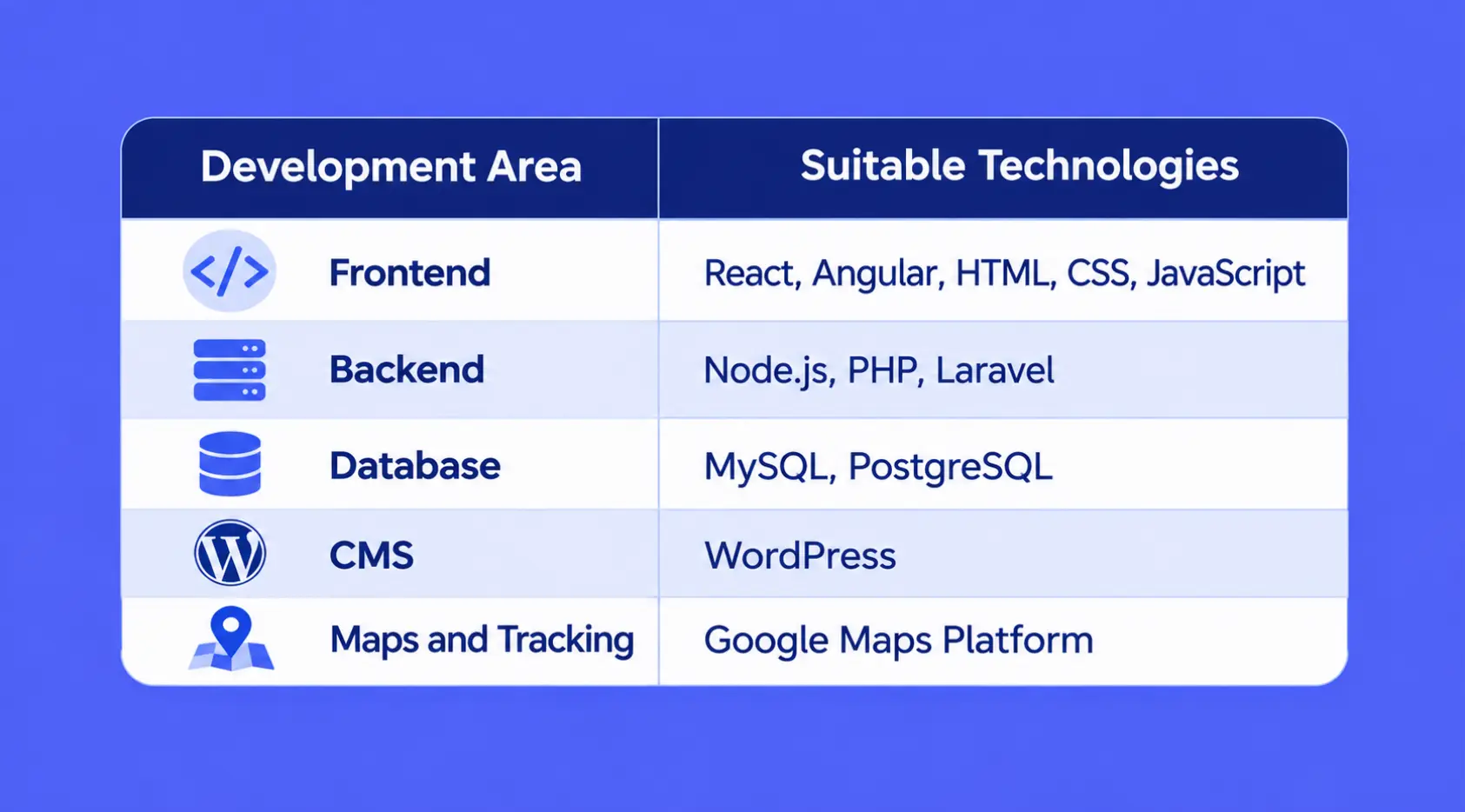
Choosing the right technology stack is important for building a secure, responsive, and scalable logistics platform.
A potential technology combination includes:
| Development area | Suitable technologies |
| Frontend | React, Angular, HTML, CSS, JavaScript |
| Backend | Node.js, PHP, Laravel |
| Database | MySQL, PostgreSQL |
| CMS | WordPress |
| Maps and tracking | Google Maps Platform |
| Cloud infrastructure | AWS, Azure, or DigitalOcean |
The final selection depends on the website’s functionality, integration requirements, expected traffic, and existing business infrastructure.
For companies requiring custom workflows and advanced integrations, BinaryMetrix Web Development Services can help identify an appropriate development approach.
How to Develop a Logistics Website: Step-by-Step Process

Building a logistics website requires a structured approach that connects business requirements with technical implementation.
- Business requirement analysis: Identify transportation services, customer requirements, operational challenges, and essential website functionality.
- Website architecture and UI/UX design: Plan navigation, page structure, booking workflows, customer dashboards, and tracking interfaces.
- Frontend and backend development: Build the customer-facing website, server-side functionality, databases, and administrative dashboard.
- API integration: Connect mapping services, payment systems, communication tools, and existing business software where required.
- Testing and quality assurance: Test booking forms, shipment tracking, account access, security, responsiveness, and website performance.
- Deployment and maintenance: Launch the website, monitor its functionality, apply security updates, and introduce improvements as business requirements evolve.
For a deeper understanding of these stages, read BinaryMetrix’s Website Development Process: Step-by-Step Guide.
Why SEO Matters for Logistics Websites
Developing a functional logistics website is only one part of building a successful digital presence. Potential customers must also be able to discover the business through search engines.
A well-planned SEO strategy should include:
- Dedicated service pages for freight, transportation, warehousing, and courier services.
- Location-specific landing pages for supported service areas.
- Search-friendly URLs and descriptive page titles.
- Relevant content addressing shipping and transportation queries.
- Internal linking between related service pages and resources.
- Mobile optimization and fast-loading website pages.
- Proper indexing, structured data, and technical SEO.
For example, a transportation company serving multiple cities can create relevant location pages that explain its actual service coverage rather than publishing repetitive pages with little useful information.
BinaryMetrix also provides SEO services to help businesses improve their online visibility and attract relevant organic traffic.
Conclusion
A modern logistics website is more than a digital business profile. It can become an essential operational platform that connects customers, transportation teams, warehouses, and business administrators.
Features such as shipment booking, real-time tracking, quotation management, fleet coordination, and automated notifications help transportation companies improve service visibility and customer communication.
The right development approach starts with understanding business requirements and selecting technology that supports current operations while allowing future expansion.
Whether you operate a courier company, freight forwarding business, or transportation service, a professionally developed website can help streamline workflows and strengthen your digital presence.
Looking to develop a logistics website for your transportation business? Connect with BinaryMetrix to discuss your requirements and build a digital solution aligned with your business goals.









 +91-7982030802
 +1(315) 585-1155