
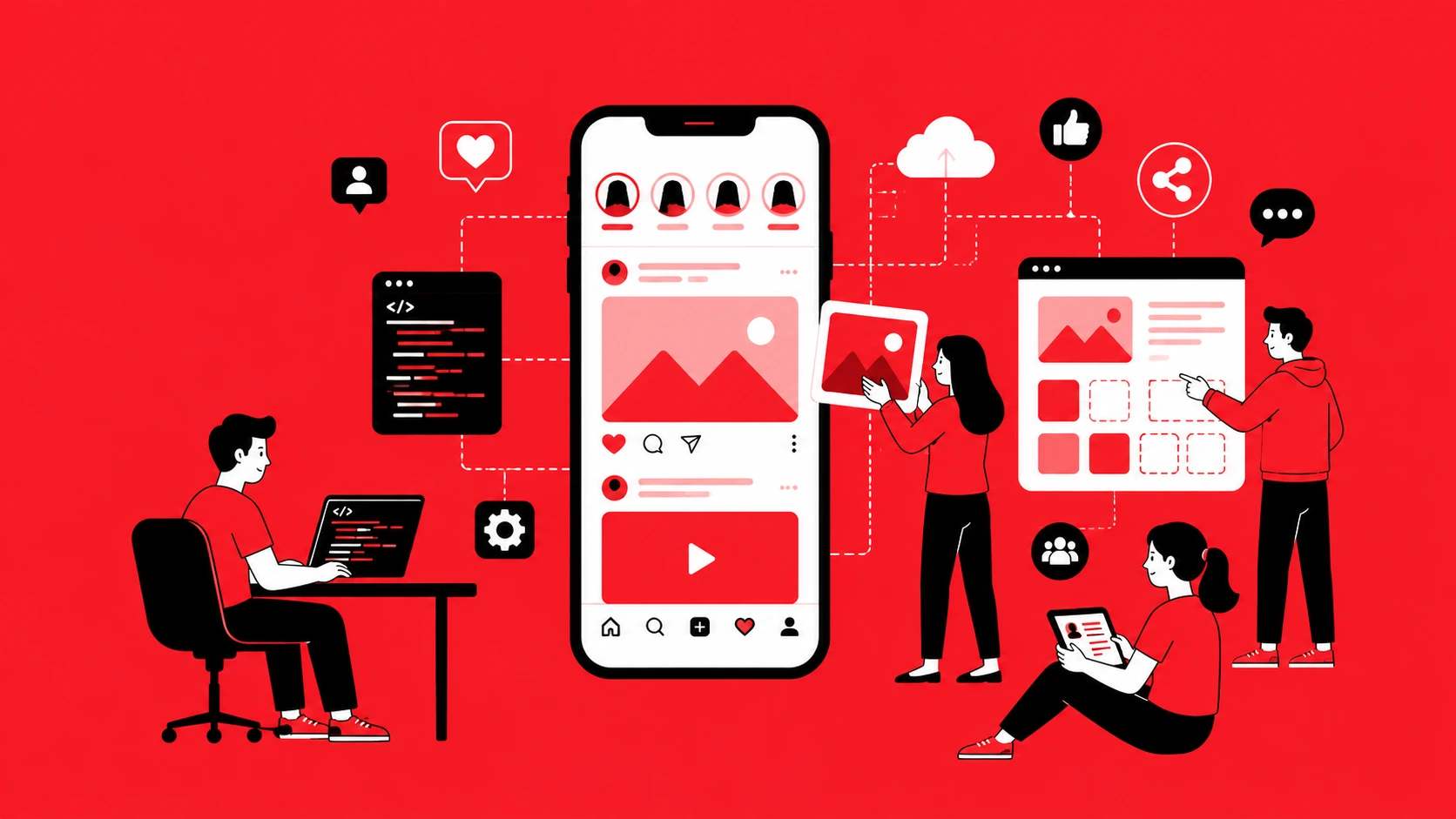
Let me be honest with you about something most agencies won’t say upfront: building a social media app is not just a tech project. It’s a people project. And if the company you hire doesn’t understand that difference, you’ll end up with a beautifully coded app that nobody wants to open twice.
I’ve seen this happen. A founder spends eight months and a significant budget building a platform. The UI looks sharp. The backend holds up under testing. They launch. And then… silence. Not because the app was buggy, it wasn’t, but because nobody on the development team ever asked: why would a real person choose this over what they’re already using?
That question is what separates a thoughtful social media app development company in USA from a code factory. It’s also why businesses that take social networking seriously are increasingly turning to custom social media app development rather than bolting features onto someone else’s platform.
Social Media in 2026: It’s Not What You Think
People keep saying social media is “saturated.” Tell that to the founders who quietly launched niche community apps this year and built 40,000-person waitlists before writing a single line of backend code.
The mass-audience era of Facebook and early Twitter is over. What’s growing instead is specific. Intentional. Community apps for nurses. Video platforms for independent filmmakers. Audio rooms for language learners. Local neighborhood networks that replace the HOA newsletter nobody reads.
A few things fuel this:
- Creator economy has matured to the point where creators want ownership, not just reach. Posting on someone else’s platform is a job. Owning your platform is a business.
- Short-form video completely reset user expectations. Scroll behavior, attention patterns, and content formats all changed. Apps that haven’t adapted feel dated immediately.
- Mobile-first users now expect app-level experiences even from brands that used to live on desktop. Your community doesn’t want to open a browser.
- AI-driven personalization went from “nice to have” to something users notice when it’s missing. A feed that doesn’t learn feels broken.
What this means for you: the opportunity isn’t to build “another social app.” It’s to build a social app for a specific group of people who feel underserved by what exists.
The Features That Decide Whether Users Stay or Leave
Here’s something I’ve noticed from watching app launches: most teams overbuild on features and underbuild on feel. They pack in everything: groups, events, live streaming, polls, badges, and ship something that technically does a lot but emotionally connects with nobody.
The apps that stick tend to start with fewer features and get them deeply right.
What users actually need from day one
- Sign up that takes under a minute: Social login (Google, Apple) isn’t optional anymore; it’s table stakes. Every extra field you add to that first screen costs you, users.
- Profiles that feel personal: A photo and a bio are the floor. Let people show who they actually are.
- Real-time messaging that works: Not “works most of the time.” Users will tolerate a lot, but they will not forgive slow messages in a social app. That’s the core promise.
- A content feed that improves over time: Static, chronological feeds felt fine in 2012. Now they feel like a step backward.
- Push notifications that earn trust: Over-notify, and users turn them off forever. Under-notify, and they forget you exist. It’s a real calibration problem that most teams don’t take seriously enough.
- Stories, reels, or short videos: Depending on your audience. The format matters less than the fact that people expect it.
What your admin side needs (that nobody talks about enough)
- Content Moderation Tools: Not just a report button. Actual workflows, queues, and moderation logs. Without this, your platform becomes unusable, and your team gets overwhelmed.
- A Real Analytics Dashboard: Not just vanity metrics. You need retention curves, session depth, and feature adoption rates.
- Monetization Controls: built in from the start, not retrofitted six months later.
- Security and Privacy Settings: that are genuinely configurable, not one toggle labeled “private.”
The backend of a social app is where most underfunded projects collapse. The user-facing polish grabs attention in demos. The admin infrastructure is what keeps the whole thing from burning down six months post-launch.
Tell us your idea in 15 minutes. We'll tell you what's viable, what's not, and where the real opportunity is.
Book a free discovery callFive Types of Social Apps Worth Building in 2026
Video-First Creator Platforms
Short-form video is still the format with the highest organic engagement. A niche TikTok-style platform for chefs, for DIY builders, and for coaches can dominate a small market before any big player notices you exist. Key social networking app features here: upload tools, editing filters, AI-suggested content, and creator monetization from day one.
Community and Interest Networks
Honestly, these are some of my favorite apps to think about. A platform for competitive chess players. A local parent network. A forum with real-time chat for indie game developers. Community-driven platforms are sticky in a way that general social networks can’t replicate, because the belonging feels real and specific.
Professional Networking Apps
LinkedIn carved out an enormous market but left enormous gaps. Vertical professional networks for architects, for nurses, and for logistics professionals are growing fast. The key is making the professional identity feel natural, not performative.
Audio and Podcast Social Apps
Clubhouse proved the format had legs even when the company itself stumbled. Voice-first social, podcast communities, live audio rooms, these work particularly well for audiences who consume content on the move.
Dating and Matchmaking Platforms
One of the most reliably monetized app categories, year after year. Modern users expect more than swiping: AI-based recommendations, video profiles, safety features, and verified identities have become baseline expectations.
Custom vs Ready-Made Social Media Apps: Key Differences
| Feature | Custom App Development | Ready-Made Solution |
| Branding | Fully yours | Boxed in by templates |
| Scalability | Built for your growth curve | Often hits hard ceilings |
| Security | Designed to your standards | Generic defaults |
| Features | What your users actually need | Whatever the vendor offers |
| Monetization | 100% yours | Revenue sharing, platform fees |
| Long-Term Flexibility | Adapt as the market shifts | Wait for vendor updates |
Look if you have a $5,000 budget and need something live in a month to test a hypothesis, a ready-made tool might be the right call. No shame in that.
But if you’re building a real product with real users and real revenue expectations? Custom social media app development is not a luxury. It’s the foundation. Trying to scale a template-based platform past a few thousand users is like trying to renovate a rented apartment, you’re always working around limitations that aren’t yours to solve.
Skip the sales pitch. Talk directly with one of our senior engineers about your stack, your timeline, and your constraints.
Schedule a technical consultWhat BinaryMetrix Brings to Social Media App Development Services
BinaryMetrix operates as a full-service social networking app development company, meaning they don’t hand you a design mockup and disappear. They handle the full lifecycle: strategy, design, development, deployment, and the ongoing work after launch that most agencies conveniently leave out of the sales conversation.
Their app development services USA clients rely on include:
- Android and iOS native development is purpose-built for each platform’s performance standards
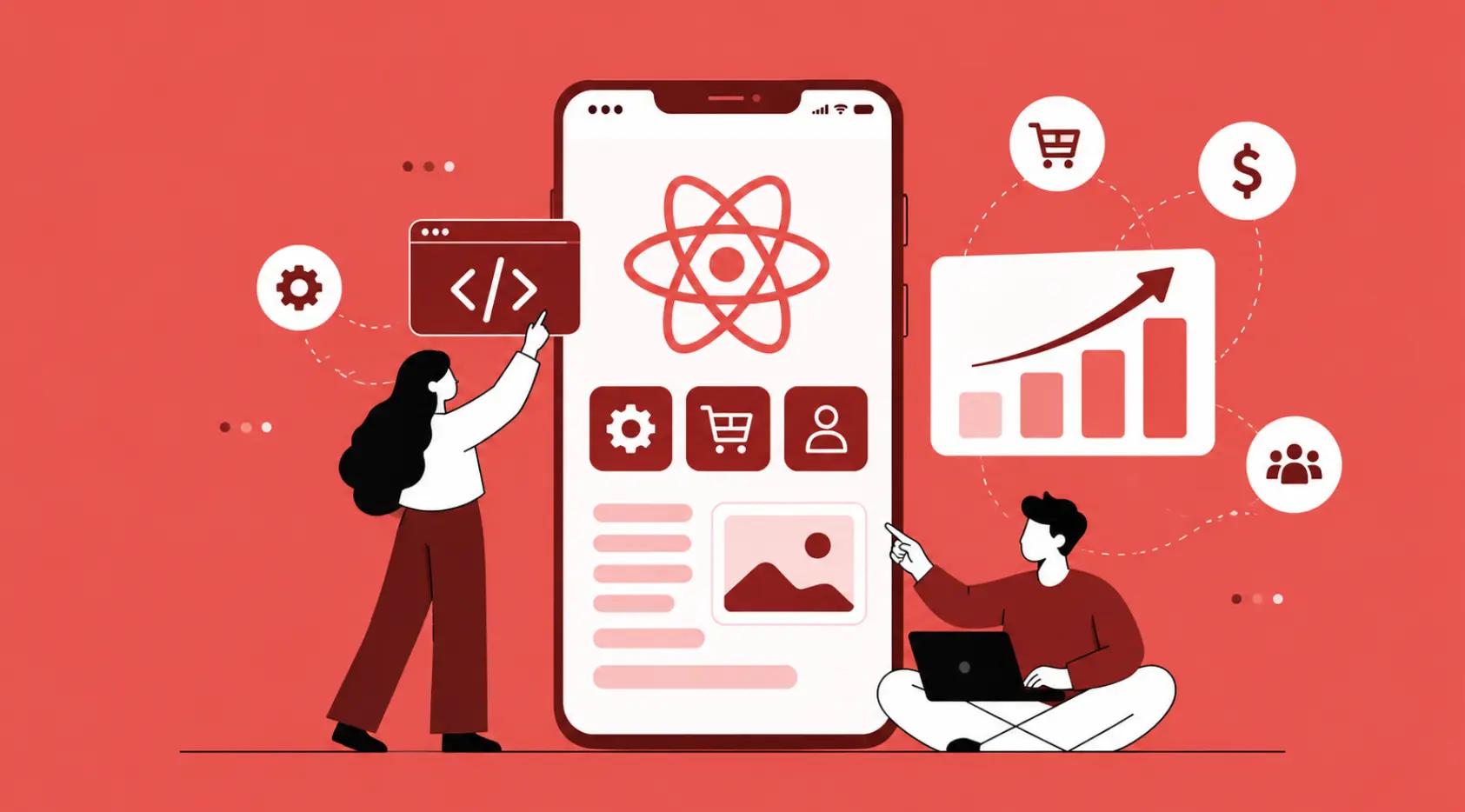
- Flutter and React Native cross-platform builds that don’t feel like compromises
- UI/UX design grounded in how real users actually behave (not just what looks good in a Dribbble presentation)
- Backend development with scalability built into the architecture from the start
- API integrations, payments, social logins, analytics, third-party tools
- Cloud infrastructure AWS, Google Cloud, and Azure configuration and management
- QA and testing across devices, load conditions, and edge cases
- Post-launch maintenance and support because a shipped app is a living product
The tech stack Flutter, React, Node.js, Laravel, PHP is chosen per project, not per preference. That matters. A team that knows one framework deeply will recommend it regardless of whether it fits your product. BinaryMetrix’s range means the recommendation you get is actually tailored to what you’re building.
What you don’t get with them: vague timelines, scope that quietly expands, and handoffs to junior developers after the sales call. Transparent communication and dedicated support are part of how they work, not promises on a landing page.
Social Media App Development Process at BinaryMetrix
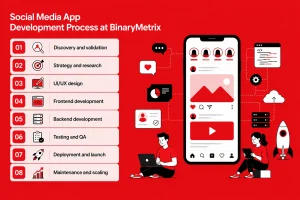
Here’s how social media mobile app development actually unfolds at BinaryMetrix:
- Discovery and validation: Before any design begins, they dig into your market, your users, your competitive landscape
- Strategy and research: Feature prioritization, technology recommendation, roadmap
- UI/UX design: From wireframes to high-fidelity prototypes to user testing
- Frontend development: The interfaces your users will live in every day
- Backend development: Data architecture, APIs, server logic, scalability design
- Testing and QA: Functional, security, performance, and device testing
- Deployment and launch: App store submission, infrastructure setup, go-live monitoring
- Maintenance and scaling: Iteration based on real-world usage data
No surprises. No “we’ll figure that out later.” Each phase has defined outputs and checkpoints.
Where Social Networking App Development Is Heading
The social media app developers building the most interesting products right now aren’t chasing features. They’re chasing behaviors. A few patterns worth watching:
AI is moving from feed curation into content generation and smart moderation; things that used to require entire teams are being handled automatically. AR layers in social apps are becoming genuinely useful rather than gimmicky. Creator monetization tools, tipping, subscriptions, and paid communities are now expected features, not premium add-ons. And blockchain-based privacy, slow-moving as it’s been, is starting to find real traction with users who’ve grown skeptical of how their data gets handled.
The platforms that are built for these shifts now will feel prescient in two years. The ones that ignore them will be retrofitting frantically.
Conclusion
Most businesses know they need a social media presence. Fewer have figured out that owning that presence through a platform built around their community is an entirely different kind of leverage.
Choosing the right social media app development company in USA is the decision that determines whether your idea becomes a product people depend on, or a launch that didn’t quite find its audience. BinaryMetrix has the technical depth, the cross-platform expertise, and the track record to help you build something that actually matters to the people it’s built for.
If you’re ready to move from concept to something real, reach out to BinaryMetrix for a no-pressure consultation. Sometimes that first conversation is the clearest thing you’ll do all month.
Turn your social app idea into a real product — without the usual agency runaround.
Start your project with BinaryMetrix




 +91-7982030802
  +1(315) 585-1155