
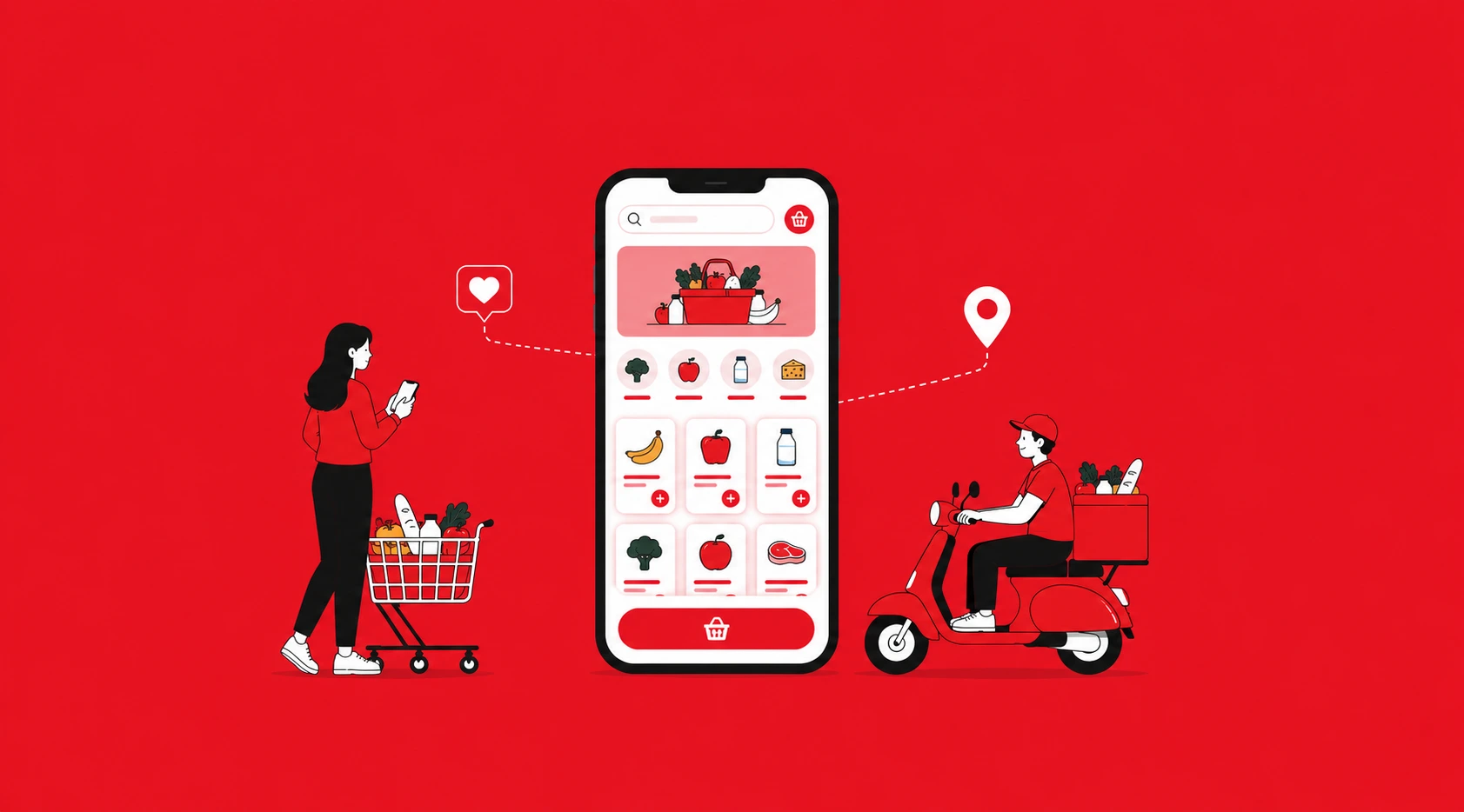
Grocery delivery app development is genuinely hard to get right. The market opportunity is real – groceries are one of the few things people buy on a tight, predictable schedule, which makes lifetime customer value much higher than most e-commerce categories. But Instacart clone app development isn’t just building a storefront with a tracking screen. It’s real-time logistics, multi-vendor inventory, payment compliance, and keeping drivers, stores, and customers happy simultaneously. Budget $80,000-$150,000 for a focused MVP and 4-6 months with a capable team. Go cross-platform with Flutter from day one – you’ll thank yourself later.
So what exactly is an Instacart clone app?
The phrase gets used loosely. When developers talk about Instacart clone app development, they don’t mean a line-for-line copy of Instacart. What they mean is a grocery marketplace app with the same core mechanic: customers browse and order through their phone, a shopper or driver picks up the order, and it arrives in hours.
Your version can look completely different from Instacart. Maybe you’re focused on organic produce in one city. Maybe you’re building for a chain of local supermarkets that wants its own branded app. Maybe it’s a multi-vendor grocery marketplace app where independent stores list their inventory side by side. The underlying architecture is similar in all those cases, even if the experience on the surface isn’t.
What makes Instacart like app development genuinely tricky is that you’re solving three problems at once: a great shopping app for consumers, a reliable job tool for drivers, and a dashboard that store owners can actually use. Nail one and mess up the other two and your launch will be rough.
Why this market still has room
Here’s something that surprises people: Instacart’s dominance doesn’t actually close the market. Regional players consistently outperform national apps in areas they focus on, because local relationships matter in grocery. A neighborhood app partnered with three beloved local stores will retain customers that Instacart doesn’t.
There’s also the white-label opportunity. Plenty of mid-size grocery chains want their own branded grocery delivery mobile app development rather than sending customers into a third-party marketplace. That’s a real, fundable business case.
And yes, the recurring revenue angle is as good as it sounds. People buy groceries every single week. If your app becomes someone’s Tuesday routine, that’s a very different retention dynamic than a travel app they open twice a year. On-demand grocery delivery app development has some of the best long-term unit economics in the mobile space when you get retention right.
What features actually matter at launch
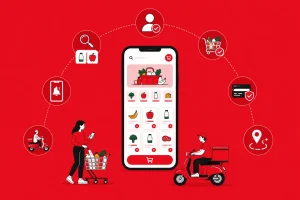
This is where a lot of first-time founders go wrong. They build the full vision before they have a single real user, then discover half of what they built doesn’t match how people actually shop.
Start with what’s genuinely non-negotiable:
- Getting people in the door: Login, profile, saved addresses. Nothing fancy. Social login (Google/Apple) dramatically reduces drop-off during onboarding, which is worth the extra day of dev work.
- Actually finding things to buy: Product catalog with real search. Not just basic keyword matching – grocery shoppers type things like “whole grain” or “lactose free” and expect relevant results. Autocomplete and category filters matter more than most people budget for.
- Paying and not abandoning: Cart, checkout, payment. The checkout flow needs to be two or three taps max. Every extra step you add costs you a percentage of completed orders. Card payments are table stakes; Apple Pay and Google Pay are worth adding early because they reduce checkout friction significantly.
- Knowing where the order is: Real-time tracking and notifications. This is actually the feature users care about most after they’ve ordered. If the app goes quiet after “order confirmed,” expect angry reviews.
- Getting the order there: Delivery management on the backend. Driver assignment, route optimization, status updates flowing back to the customer. This is where the technical complexity lives.
That’s your MVP. Everything else – AI recommendations, loyalty programs, subscription tiers, [multi-vendor support], advanced analytics dashboards – comes after launch when you have real user behavior to design against.
Our team has shipped Instacart-like apps across 10+ markets. Tell us what you're building and we'll map out the right approach.
Talk to Our TeamThe tech stack question
People spend too long agonizing over this. Here’s the practical answer.
For mobile app development on a grocery delivery project, Flutter is the best starting point for most teams right now. It gives you one codebase that compiles to native iOS and Android, performance that’s genuinely close to native, and a component library that’s mature enough to build real production apps. React Native works too. What doesn’t work is planning to build separate native apps from day one unless you have a very specific reason and a budget to match.
On the backend, Node.js handles real-time features well – order status updates, live driver location, notifications firing off at the right moments. You’ll want WebSocket support for the live tracking parts. PostgreSQL for your main data (users, orders, product catalog), Redis for caching and anything that needs to be fast. Google Maps API for routing and address handling.
For payments, Stripe is the default choice for US-focused apps. It’s well-documented, handles PCI compliance cleanly, and supports Apple Pay, Google Pay, and card payments without much additional work. Don’t build your own payment handling.
Cloud hosting on AWS or Google Cloud is fine. Don’t over-engineer the infrastructure for your first version – you can scale it later when you have real load to respond to.
What Does This Actually Cost?
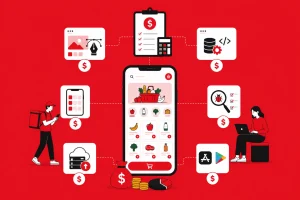
Budget conversations are uncomfortable but necessary. Here’s a realistic breakdown for an Instacart clone app development project:
Design and UX: Runs $10,000-$25,000 for wireframes through final UI across both platforms. This is almost always underestimated. Good design on a grocery app isn’t decoration; it’s directly tied to conversion rates.
Frontend development: The customer-facing app is roughly $20,000-$60,000, depending on complexity and whether you’re using cross-platform or native development. Add the driver app, and you’re adding another $15,000-$30,000.
Backend development: Includes APIs, databases, real-time features, payment integration, and the admin dashboard. This typically runs $20,000-$80,000. The range is wide because logistics complexity varies enormously.
QA and testing: Don’t skip this. Budget $5,000-$15,000. An app that crashes when a driver accepts an order is an app that gets one-star reviews on day one.
App store submission, server setup, and launch costs: Add another $5,000-$10,000.
So, for a six-month MVP with a solid 4-5 person team, you’re realistically looking at $80,000-$150,000. Want multi-vendor grocery app development with separate merchant storefronts, settlement reporting, and commission tracking? Add 30-50% to that budget and another 3-4 months to the timeline.
Post-launch maintenance: Costs $2,000-$5,000 per month, and it’s not optional. Apps need updates, servers need monitoring, and bugs happen.
iOS vs Android – the real answer
Build for both. Seriously.
The old debate about iOS-first versus Android-first made more sense when cross-platform frameworks were immature. Today, building separate native apps is a choice you make when you have very specific platform requirements – hardware integration, platform-exclusive features – not a default starting point.
Flutter development gives you 60-70% code reuse across iOS and Android, which means your grocery delivery mobile app development timeline drops by nearly half versus maintaining two separate native codebases. The performance gap between Flutter and native is real but small. For a grocery app where the heavy lifting is API calls and maps rendering, not GPU-intensive graphics, users won’t notice.
If you’re targeting higher-income urban areas in the US, iOS users represent a disproportionate share of grocery delivery spending. But Android has global majority market share and dominates in many demographics. There’s no good reason to leave half your market on the table during launch.
Building a multi-vendor grocery marketplace
This is a different animal from a single-store delivery app and worth addressing separately because the architecture decisions compound.
In a multi-vendor grocery marketplace app, you’re not just building a storefront – you’re building a platform that stores operate within. Each merchant needs their own product catalog management, their own order stream, and their own payout reports. Inventory synchronization becomes a real-time problem rather than a daily batch job. Disputes between customers and merchants need a process, not just an email address.
The commission structure matters too. Platforms typically take 15-30% per order and handle customer acquisition, logistics, and infrastructure. Merchants bring inventory and sometimes fulfillment. Getting the economics right before you build the commission tracking is important because changing it later is painful.
Add 3-6 months and 30-50% to your development budget if you’re going multi-vendor. It’s not just more features – it’s a fundamentally more complex system.
Marketing and getting your first users
The app launch is not the hard part. Getting the first 500 recurring customers is.
Grocery delivery has a chicken-and-egg problem in new markets: customers won’t use an app with three stores on it, and stores won’t invest in an integration with no customers. Most successful launches pick one neighborhood, sign up 5-10 stores manually, and do aggressive local marketing before expanding. Trying to go city-wide immediately usually ends in thin coverage everywhere and good coverage nowhere.
Launch marketing typically runs $10,000-$50,000 – local ads, some influencer partnerships, PR coverage if you can get it. After that, ongoing user acquisition via Google and Meta ads costs $3-$8 per install for grocery apps in competitive markets.
Retention is where the real money is, though. Push notifications, email, and loyalty programs do the heavy lifting. Digital marketing strategies built around repeat purchase behavior – not just acquisition – are what separate apps that grow from apps that plateau after the launch spike.
Choosing the right development partner
Building a grocery delivery app in-house is possible. But it’s a genuinely hard project – real-time systems, multi-platform development, payment compliance, logistics integration, and usually a tight timeline. The teams that do it well have done something similar before.
Working with an experienced mobile app development partner is often faster and cheaper than it looks when you factor in the cost of mistakes made the first time. What to actually look for: a team that’s built marketplace or delivery apps before (not just e-commerce), real backend experience with real-time features, and a post-launch support model that isn’t just handing you the code and disappearing.
The gap between a technically functional grocery app and one that users actually love usually comes down to the details – how fast search is, how clear the tracking screen is, how the app behaves when an item goes out of stock mid-order. Those details are easier to get right with people who’ve shipped an app and seen what users complain about.
Try BinaryMetrix
BinaryMetrix has built mobile apps across iOS, Android, and Flutter – including marketplace and delivery platforms. Their team covers the full build from design through backend architecture, real-time features, payment integration, and ongoing support. If you’re planning an Instacart clone app or a custom grocery delivery app, talk to their team about your project scope and timeline.
BinaryMetrix builds scalable, feature-rich clone apps tailored to your market. Let's turn your idea into a live product.
Start Your Project





 +91-7982030802
  +1(315) 585-1155