
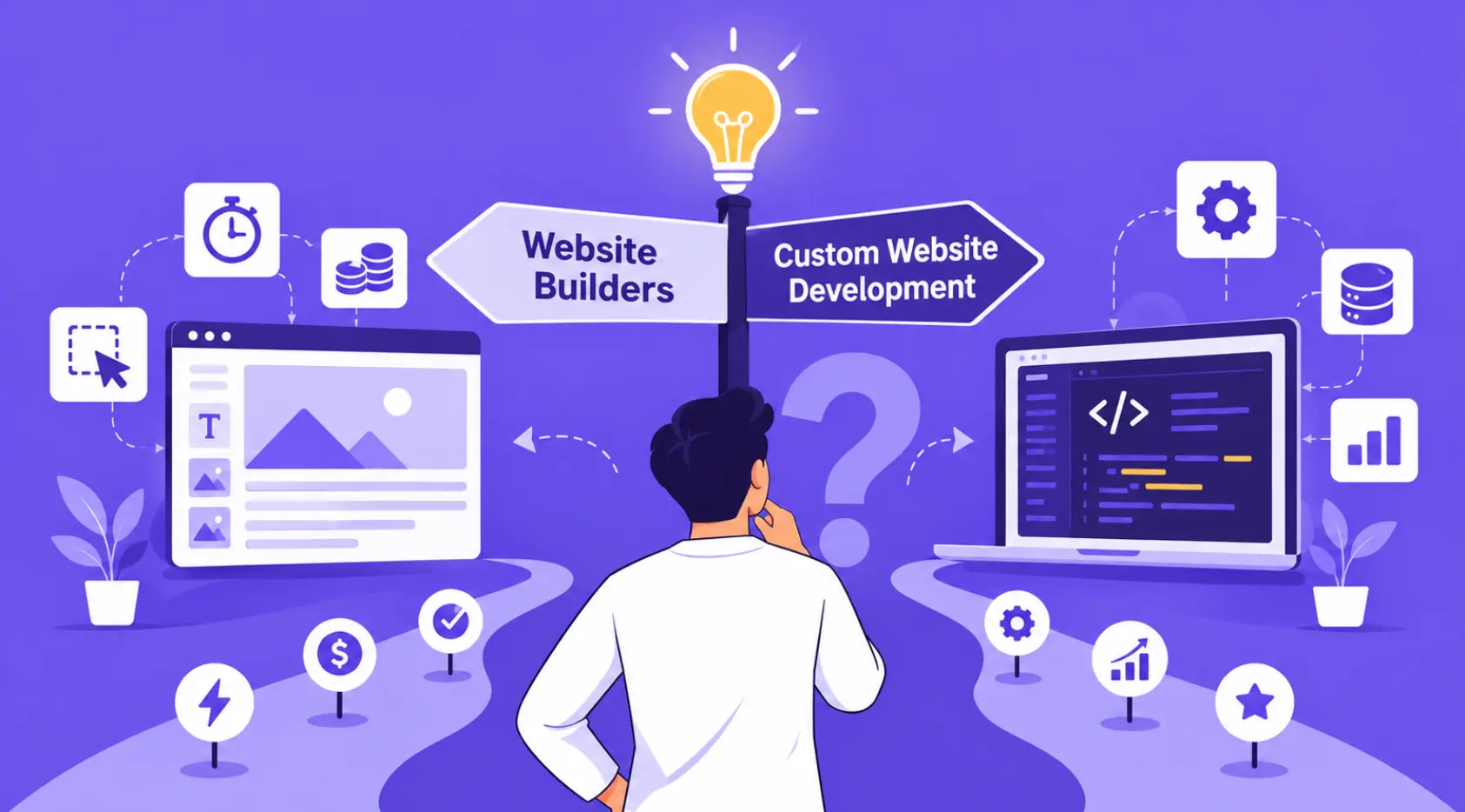
Choosing the right way to build a website is an important decision for any business. A professional website helps establish credibility, attract potential customers, showcase services, and generate leads. However, before investing in one, businesses need to decide whether to use a website builder or invest in custom website development.
Website builders offer ready-made templates, drag-and-drop editing, and relatively quick setup. Custom website development, on the other hand, allows businesses to create a digital platform tailored to their goals, customer journeys, and technical requirements.
Both options have their advantages. The right choice depends on your budget, business model, expected growth, and the functionality your website needs to deliver.
In this guide, we compare custom website development vs website builders across cost, flexibility, scalability, SEO, performance, and long-term value to help you make an informed decision.
What Is a Website Builder?
A website builder is a platform that allows users to create websites using pre-designed templates and visual editing tools, usually without writing much code. Popular examples include Wix, Squarespace, and Shopify for e-commerce businesses.
These platforms simplify the website creation process by providing hosting options, design templates, content management features, and integrations within a single environment.
Website builders are particularly useful for small businesses, freelancers, startups, and entrepreneurs who need a functional website without a lengthy development process.
Key Benefits of Website Builders
- Lower initial investment: Many platforms offer affordable subscription plans and free or low-cost templates.
- Faster launch: Businesses can publish a basic website within days, depending on the content and setup requirements.
- Easy content management: Non-technical users can update text, images, and product listings through visual editors.
- Built-in features: Hosting, basic security features, contact forms, and integrations may be included in the chosen plan.
- Minimal technical involvement: Businesses can manage many routine website tasks without hiring a developer.
However, these advantages come with certain limitations. Advanced functionality, specialised integrations, extensive design changes, and platform-specific restrictions can become challenging as business requirements evolve.
What Is Custom Website Development?
Custom website development involves designing and developing a website around a business’s specific objectives, brand identity, workflows, and technical requirements. Instead of relying entirely on a pre-built template, developers create tailored layouts, functionality, integrations, and user experiences.
Depending on the project, a custom website may be built using technologies such as React, Angular, Node.js, PHP, or a content management system such as WordPress.
Businesses can also combine a flexible CMS with custom themes and functionality. This approach allows teams to manage website content conveniently while maintaining greater control over the design and technical implementation.
For businesses with specialised requirements, professional custom web site development services can help create a platform that supports current operations and future expansion.
Key Benefits of Custom Website Development
- Tailored functionality: Features are developed around actual business requirements rather than limited to a template’s capabilities.
- Greater design control: The website can reflect the brand’s identity, positioning, and customer journey.
- Scalability: New features, integrations, and workflows can be planned around future business needs.
- Technical flexibility: Developers have greater control over architecture, integrations, and performance optimisation.
- SEO implementation: Site structure, metadata, internal linking, structured data, and other technical elements can be planned according to the project’s requirements.
Custom development requires more planning and investment, but it can offer greater value when the website plays a central role in business growth.
Custom Website Development vs Website Builders: A Detailed Comparison
The biggest difference between these options is not simply how a website is created. It is how much control a business has over its digital platform and how well that platform can support changing requirements.
1. Initial Cost and Long-Term Investment
Website builders generally have a lower entry cost. Businesses can select a subscription plan, choose a template, add content, and launch without paying for an extensive development project.
However, the total cost may include recurring subscriptions, premium themes, paid applications, transaction fees, and additional features. These expenses can increase as the website becomes more complex.
Custom website development typically requires a higher initial investment because it involves planning, design, development, testing, and deployment. Ongoing expenses may include hosting, maintenance, security updates, and technical support.
The important consideration is the total cost of ownership, not just the launch price.
For example, a small consultancy website with a few service pages may work perfectly well on a builder. A business requiring customer portals, custom pricing, automated workflows, and multiple system integrations may find that a tailored solution offers better long-term value.
2. Design Flexibility and Brand Identity
Website builders provide templates that can be customised to a certain extent. They are useful for businesses that want a professional appearance without developing every design element from scratch.
The limitation is that the available layouts and components may restrict how closely the website can match a particular brand or user experience.
Custom development provides greater control over page layouts, navigation, interactive elements, and customer journeys. Businesses can design landing pages, service pages, dashboards, and conversion paths around their audience’s needs.
This is particularly valuable for companies operating in competitive markets where their website must communicate a distinctive value proposition.
3. Scalability and Future Growth
A website that meets your requirements today may not be sufficient two or three years from now.
Website builders can support growth through available apps, integrations, and higher-tier plans. For many small and medium-sized businesses, these capabilities are more than sufficient.
Problems may arise when a business requires functionality that the platform does not support, needs deeper control over its data, or wants to connect several internal systems.
Custom development allows the architecture to be planned around expected growth. Businesses can add new features, integrate external applications, and modify workflows as requirements change.
If your organisation expects to expand its digital operations, reviewing BinaryMetrix’s website development services can help you understand the options available for building a solution around your business needs.
4. Website Performance and User Experience
Website speed and usability affect how visitors interact with your business. Slow-loading pages, confusing navigation, and poorly designed mobile experiences can create friction and reduce the likelihood of conversions.
Website builders often provide hosting infrastructure and performance features, but the final results depend on the platform, template, scripts, images, integrations, and configuration.
Custom websites offer greater control over code, resource loading, caching, and technical optimisation. Developers can identify unnecessary functionality and optimise the website for its intended use.
However, custom development does not automatically guarantee better performance. Poor coding, inadequate hosting, and insufficient testing can also affect a custom-built website.
Whichever option you choose, performance should be measured through real-world loading behaviour, mobile usability, and Google’s Core Web Vitals.
5. Search Engine Optimisation (SEO)
Both website builders and custom websites can rank in search engines. The platform alone does not determine SEO performance.
Website builders often provide essential SEO settings, including editable page titles, meta descriptions, image alt text, canonical settings, and sitemap generation. These features are sufficient for many standard business websites.
Custom development provides more flexibility when implementing advanced SEO requirements, such as specialised URL structures, complex internal linking, structured data, rendering strategies, and large-scale content architectures.
For example, a business with hundreds of service and location pages may need precise control over indexation, canonicalisation, pagination, redirects, and crawl efficiency.
It is important to remember that technical flexibility is only one part of SEO. High-quality content, relevant search intent, useful information, and a strong user experience remain essential.
Businesses should therefore evaluate the platform based on the SEO tasks they actually need to perform, rather than assuming that a custom website will automatically achieve higher rankings.
6. Integrations and Business Automation
Many businesses rely on external tools to manage sales, customer relationships, inventory, payments, analytics, and marketing campaigns.
Website builders typically offer integrations through built-in features, application marketplaces, and supported APIs. These options work well for common business requirements.
Custom development is more suitable when integrations involve specialised workflows, complex data exchanges, custom authentication, or multiple business systems that must communicate reliably.
For an online store, this might include synchronising inventory with an ERP system, applying customer-specific pricing, or connecting order processing to a fulfilment platform.
Businesses planning these capabilities should evaluate e-commerce website development services before deciding whether a standard platform or a more tailored implementation is appropriate.
7. Maintenance, Security, and Technical Support
Website builders reduce the technical burden by managing much of the underlying infrastructure. Depending on the provider and subscription, hosting, platform updates, and certain security measures are handled centrally.
However, businesses still need to manage account access, content, third-party integrations, privacy requirements, and platform-specific risks.
Custom websites offer greater control over technical decisions, but that control also creates responsibilities. Maintenance may involve software updates, dependency management, vulnerability testing, backups, monitoring, and performance improvements.
Neither approach is automatically more secure. Security depends on implementation quality, ongoing maintenance, access controls, hosting, and the provider’s security practices.
Before making a decision, businesses should consider who will maintain the website after launch and how much technical support they can realistically provide.
Website Builders vs Custom Website Development: Comparison Table
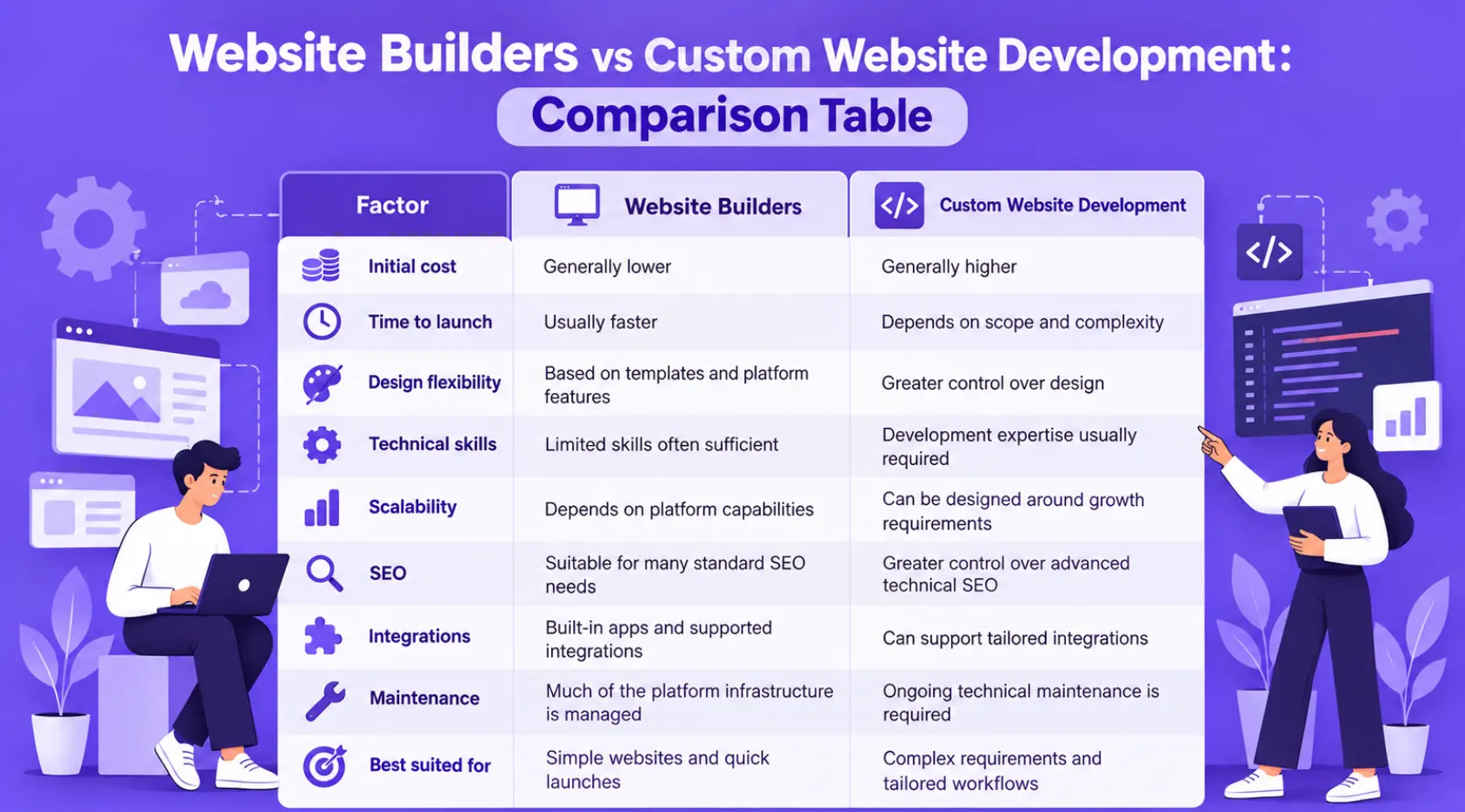
| Factor | Website Builders | Custom Website Development |
| Initial cost | Generally lower | Generally higher |
| Time to launch | Usually faster | Depends on scope and complexity |
| Design flexibility | Based on templates and platform features | Greater control over design |
| Technical skills | Limited skills often sufficient | Development expertise usually required |
| Scalability | Depends on platform capabilities | Can be designed around growth requirements |
| SEO | Suitable for many standard SEO needs | Greater control over advanced technical SEO |
| Integrations | Built-in apps and supported integrations | Can support tailored integrations |
| Maintenance | Much of the platform infrastructure is managed | Ongoing technical maintenance is required |
| Best suited for | Simple websites and quick launches | Complex requirements and tailored workflows |
The comparison highlights a general pattern, not an absolute rule. A well-configured website builder can outperform a poorly developed custom website. The right choice depends on execution and business requirements.
Which Option Offers Better Value for Different Businesses?
There is no universal winner. The better option is the one that meets your business requirements without creating unnecessary cost or complexity.
Startups and Small Businesses
A website builder is often a sensible starting point for businesses validating an idea, building an initial online presence, or operating with limited resources.
If your website mainly needs service information, contact forms, testimonials, and basic lead generation, a builder may provide everything you need.
Custom development becomes more attractive when the website requires specialised functionality or when digital operations become central to the business model.
Growing Businesses and Service Providers
Growing companies often need more control over lead generation, customer journeys, integrations, and brand presentation.
A website builder may still be sufficient, particularly if its existing features support your plans. However, businesses experiencing repeated limitations should compare the cost of workarounds against the benefits of a tailored solution.
The goal is to select technology that supports growth without paying for unnecessary complexity.
E-commerce Businesses
For smaller online stores, platforms such as Shopify and WooCommerce can provide practical ways to manage products, payments, and orders.
Businesses with complex catalogues, specialised checkout requirements, custom pricing, or extensive integrations may benefit from a more customised approach.
The decision should account for product management, operational workflows, maintenance, transaction costs, and future expansion.
Enterprises and Businesses With Complex Requirements
Larger organisations often require advanced permissions, internal system integrations, customer portals, reporting dashboards, and specialised security controls.
In these situations, custom website development may offer stronger alignment with operational requirements. Depending on the project, a hybrid solution using an established platform with custom functionality may also be appropriate.
How to Choose the Right Website Development Approach
Before committing to either option, ask yourself five practical questions:
- What does the website need to achieve? Define whether the main goal is brand awareness, lead generation, online sales, customer service, or operational automation.
- What is your realistic budget? Consider initial development, subscriptions, hosting, maintenance, integrations, and future changes.
- Which features are essential? Separate must-have functionality from features that can be introduced later.
- How much growth do you expect? Evaluate whether the platform can support your anticipated traffic, content, customers, and business processes.
- Who will manage the website? Consider the availability of internal resources, technical expertise, and ongoing support.
Answering these questions helps prevent a common mistake: choosing a platform based only on price or appearance without considering how the website will support the business over time.
Conclusion: Invest in the Website Your Business Actually Needs
Website builders and custom website development both offer practical advantages. Website builders are cost-effective, accessible, and suitable for launching straightforward websites quickly. Custom development provides greater flexibility, control, and opportunities to create functionality around specific business needs.
For a small business with standard requirements, a website builder may offer the best value. For a growing organisation that needs specialised integrations, advanced workflows, or a highly tailored customer experience, custom development may justify the additional investment.
The smartest decision is to focus on total ownership costs, business objectives, technical requirements, and future plans rather than choosing the cheapest option by default.
At BinaryMetrix, we help businesses evaluate their digital requirements and identify suitable website development approaches. Whether you need a straightforward business website or a tailored digital solution, the objective is to build a platform that supports your goals today and remains useful as your business evolves.
Ready to plan your next website project? Explore BinaryMetrix’s website development services or contact our team to discuss your requirements.






 +91-7982030802
 +1(315) 585-1155