
So you’ve been wondering how to create a food delivery app and actually turn it into something profitable. Good instinct: this is one of the more promising corners of the on-demand economy right now. Americans order food online constantly, and that habit isn’t going anywhere. But launching a food delivery business isn’t just about having a decent idea. It takes a real plan, a technology partner who knows what they’re doing, and an app that people don’t dread opening. This guide covers how to start a food delivery business with an app: market research, business planning, features, costs, and what happens after launch, so you’re not figuring it out as you go.
Why the Food Delivery Industry Is Still a Smart Bet in 2026
Food delivery stopped being a “nice to have” a while ago. It’s a habit now. Busy schedules, more people working from home, and a general craving for restaurant-quality food without leaving the couch have pushed on-demand food delivery apps into everyday life across the U.S.
That’s genuinely good news if you’re an entrepreneur. You don’t need to out-build DoorDash or Uber Eats to make money. Plenty of smaller, local players are doing well by sticking to a specific city, a cuisine niche, or a neighborhood the big players ignore. In a way, figuring out how to create a food delivery app like DoorDash on a much smaller, sharper scale is often the smarter move for someone just starting out.
A few reasons the timing is on your side right now:
- People already trust the on-demand food delivery app model, so you’re not trying to convince anyone that ordering from an app is normal.
- Local restaurants are actively hunting for delivery partners who don’t charge the crushing commission fees the big platforms do.
- App development has gotten faster and cheaper than it was even a couple of years ago, so the barrier to entry is lower than most people assume.
How to Start a Food Delivery Business with an App: Step-by-Step
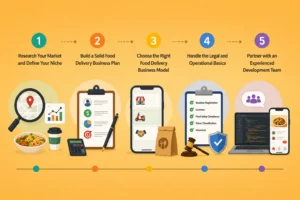
Before anyone writes a line of code, the founders who actually succeed spend time laying groundwork most people skip. Here’s how to build a food delivery app business the right way, one step at a time.
Step 1: Research Your Market and Define Your Niche
Start with a simple question: who exactly are you serving? A specific city, a cuisine type, a college campus, health-conscious eaters. Pick something. A clear niche makes your marketing far easier, and it keeps your app development from sprawling in every direction.
Then look at whoever’s already operating near you. What are they doing right? Where are they dropping the ball: slow deliveries, a thin restaurant list, fees that annoy people? Those gaps are usually where a new business finds its opening.
Step 2: Build a Solid Food Delivery Business Plan
Every solid food delivery business plan covers a few non-negotiables:
- Your target audience and the geography you’ll actually serve
- Revenue streams: commissions, delivery fees, subscriptions, in-app advertising
- What it’ll actually cost to start and to keep running
- How you plan to acquire your first hundred customers, then the next thousand
- Rough growth milestones for year one and year two
Investors will want to see this, and so will lenders. Treat it less like a document you write once and more like something you keep updating.
Step 3: Choose the Right Food Delivery Business Model
Your food delivery business model ends up shaping almost everything downstream: features, revenue, even how many people you need to hire. There are three that most businesses fall into:
- Order-only model – You handle the ordering side; restaurants deliver on their own.
- Order-and-delivery model – You run the platform and manage your own delivery drivers. This is what most on demand food delivery apps end up doing.
- Aggregator model – You partner with delivery services that already exist and just provide the app experience.
Most businesses that stick around eventually land on the order-and-delivery model. It’s more work, but it also gives you control over the customer experience and keeps the biggest share of revenue in-house.
Step 4: Handle the Legal and Operational Basics
Register the business, get whatever licenses your state requires, and understand the rules around food handling, how you classify delivery drivers, and insurance. This part varies a lot depending on where you’re launching, so it’s worth a real conversation with a local attorney rather than guessing. Nailing these fundamentals before development starts is honestly a bigger part of how to create a food delivery app than most people expect. Skip it, and you’ll pay for it later.
Step 5: Partner with an Experienced Development Team
This is really where things start to feel real. Picking a solid food delivery app development company will save you money and, more importantly, your sanity. A team that’s done this before will steer you through platform choices, which features to build first, and architecture that won’t collapse the moment you get 500 users instead of 50.
If you’re still weighing options, BinaryMetrix’s mobile app development team has built on-demand platforms across food delivery, taxi booking, and laundry services, from the first sketch to launch day.
How to Create a Food Delivery App: Must-Have Features
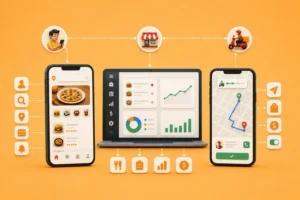
Once the business plan is solid and you’ve picked a development partner, the real work, figuring out how to create a food delivery app that people keep coming back to, begins. There isn’t one app here. There are three: the customer-facing app, the restaurant/admin panel, and the driver app, each built for a different person with different needs.
Customer App Features
- User registration and profile management
- Restaurant browsing with search and filters
- Real-time order tracking
- Multiple secure payment options
- Ratings, reviews, and easy reordering
- Push notifications for order updates and deals
Restaurant/Admin Panel Features
- Menu and inventory management
- Order acceptance and status updates
- Sales analytics and reporting
- Commission and payout tracking
Delivery Driver App Features
- GPS navigation and route optimization
- Order pickup and delivery confirmation
- Earnings dashboard
- An availability toggle so drivers control their own shifts
These food delivery app features are pretty much table stakes at this point. Users expect them without even thinking about it. Beyond that baseline, a lot of businesses layer on loyalty programs, smarter recommendations, or scheduled ordering to differentiate. A good UI/UX team makes the difference between features that exist and features people actually enjoy using, which is why it’s worth talking to a mobile app designing specialist before development kicks off, not after.
Choosing the Right Platform and Technology Stack
Part of learning how to develop a food delivery app for your business, and honestly part of how to create a food delivery app that doesn’t need a rebuild in a year, is deciding, early, which platforms you’re building for. Most founders launch on both iOS and Android at once to avoid leaving half their market behind, often leaning on cross-platform frameworks to keep timelines and budgets in check.
If you’re comparing options, BinaryMetrix offers dedicated Android app development and iOS app development, plus cross-platform work in Flutter and React Native, two frameworks that come up constantly when people talk about building on-demand food delivery apps quickly without cutting corners on performance.
Some businesses also add a companion web app, so customers who’d rather order from a laptop aren’t stuck reaching for their phone.
How Much Does It Cost to Build a Food Delivery App?
This is usually the very first question people ask, and fair enough. The honest answer is: it depends. Feature list, which platforms you build for, how polished the design needs to be. All of it moves the number. A lean MVP with basic ordering and tracking will run you a lot less than a full platform with AI-driven recommendations, loyalty programs, and heavy analytics baked in.
Broadly, the food delivery app development cost comes down to a handful of factors:
- How many platforms you’re building for (iOS, Android, web)
- How complex the features are: live tracking, in-app chat, several payment gateways
- Design and branding work
- Backend infrastructure and third-party integrations like maps, payments, and SMS
- Ongoing maintenance once the app is actually live
Guessing here rarely goes well. It’s better to get a real quote based on your specific plan. Most legitimate development companies will do a free consultation first to scope things properly before they throw out a number. That conversation is usually where founders start figuring out how to create a food delivery app that fits the budget they actually have, not the one they wish they had.
Choosing a Food Delivery App Development Company
Not every dev shop can handle the real-time, multi-user mess an on-demand platform actually is. When vetting a food delivery app development company, a few things matter more than a nice portfolio site:
- Real experience with on-demand or logistics apps, not just e-commerce
- Comfort with real-time GPS tracking and payment integrations
- Communication that doesn’t feel like pulling teeth
- Support and maintenance after launch, not just before
- Pricing that’s actually transparent, without surprise line items later
Worth a look: BinaryMetrix’s portfolio has real examples of on-demand builds: food delivery, taxi booking, and similar service platforms. In the end, the team you pick determines whether you actually pull off how to create a food delivery app that holds up once real customers and real drivers are using it daily.
Marketing Your Food Delivery App After Launch
Building the thing is honestly only half the job. Getting people to download it, and keep using it, takes deliberate work. A few tactics that consistently pay off:
- Cross-promoting with local restaurants already on your platform
- First-order discounts to knock down the friction of trying something new
- Geo-targeted ads on social and search, aimed at your actual launch area
- An email/SMS list so you’re not starting from zero with every promotion
- Actively asking for reviews and referrals early, while people still remember signing up
Search visibility matters too, maybe more than people expect. A properly optimized website and blog can bring in traffic long before your app even shows up in app store search results. If marketing isn’t where your strengths are, teaming up with an experienced SEO team can build that visibility alongside whatever paid campaigns you’re running.
Common Mistakes to Avoid When Starting a Food Delivery Business
- Skipping the MVP stage – Trying to launch every feature at once pushes back your timeline and burns through budget for no real reason.
- Ignoring the driver experience – A clunky driver app means slow deliveries, and slow deliveries mean angry customers, fast.
- Underestimating support needs – Order problems will happen. Plan for real, responsive customer support from day one, not month three.
- Picking the cheapest developer instead of the right one – It feels like saving money until you’re paying twice to fix what got rushed.
- Letting the app go stale after launch – User expectations shift constantly, and an app that stops evolving starts losing ground fast.
If you’re thinking long-term, it’s worth putting loyalty and rewards program design and AI-powered order recommendations on your roadmap as things to add once the core platform is stable. Avoiding these mistakes matters just as much as knowing how to create a food delivery app in the first place. Really, the two aren’t separate problems.
Final Thoughts
At this point you’ve got a real answer to how to create a food delivery app and what it takes to launch a food delivery business around it. The next move is turning this into action. Success here comes down to solid planning, a technology partner who’s actually done this before, and genuine care about the experience for customers, restaurants, and drivers alike.
Ready to move forward? Reach out to the BinaryMetrix team for a free consultation on your food delivery app idea, or check out the hire dedicated developers option if you’ve already got a product vision and just need experienced engineering hands on deck.






 +91-7982030802
  +1(315) 585-1155