
You type a question into Google. A page shows up that answers it almost perfectly. That’s SEO doing its job, whether you noticed it or not. So what is SEO exactly, and why does nearly every business with a website act like it’s the holy grail?
SEO stands for search engine optimization. Strip away the jargon and it just means shaping a website so search engines like Google can find it, figure out what it’s about, and put it in front of people actually looking for it. This guide covers what is SEO, how it works, why it matters, and how to start using it without any technical background at all.
What Is SEO? A Simple Definition
Beginners usually land on one question first: what is SEO, really?
Plain version: SEO is the ongoing work of getting a website to rank higher in organic search results. Organic meaning unpaid. No ad spend, no sponsored tag next to your listing. You earn that spot by building something genuinely useful, technically clean, and trustworthy, both to the people reading it and the algorithms deciding who sees it.
Three things drive that, and honestly, none of them work in isolation:
- Content that actually answers what people are searching for
- Technical structure that lets search engines crawl and read the site without tripping over anything
- Authority signals, mostly backlinks and reputation, telling Google the site can be trusted
Line those three up reasonably well and pages start moving up for relevant searches. Nobody paid for that traffic. It just showed up.
How SEO Works: From Crawling to Ranking
Knowing what is SEO and how it works only gets you halfway. The rest is understanding what’s happening under the hood, so let’s open that up.
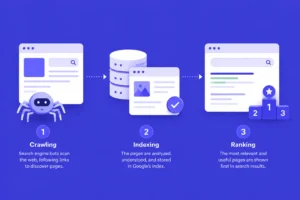
Google, like most search engines, runs roughly the same three-step process every time.
Crawling
Automated bots, called crawlers, scan the web nonstop, hopping from link to link to find pages. If a site’s navigation is a mess, or internal links are missing, some pages simply never get discovered. They exist. Google just doesn’t know it yet.
Indexing
Once a bot crawls a page, the search engine studies its content and stores it in a giant database, the index. This is the stage where Google works out what a page is actually about, pulling signals from the text, headings, images, and structured data.
Ranking
Someone runs a search. The engine digs through its index and pulls out the most relevant, useful pages first. What decides “relevant”? Content quality, keyword relevance, page speed, mobile usability, backlinks, plus a long tail of smaller signals that shift more often than most people assume.
That’s roughly how Google SEO works in practice, and it’s why a page selling a genuinely great product can still sit buried on page five while a weaker competitor sits at the top.
Why SEO Is Important for a Website
Why is SEO important for a website in the first place? Because almost nobody scrolls past page one, and the top three organic results grab the lion’s share of clicks. That’s just how search behavior works.
Here’s what strong SEO actually does for a business, in no particular order:
- It brings in people already looking for what you sell, instead of interrupting people who weren’t
- Visibility sticks around, it doesn’t vanish the moment you stop paying for ads
- Organic results tend to feel more credible to users than paid placements do
- It props up other channels too, social, email, all of it, by giving people somewhere solid to land
- It works alongside broader digital marketing, not instead of it
Small businesses especially feel this. Cost per visitor drops a lot over time compared to running ads nonstop, since the traffic keeps arriving on days nobody’s spending a dime.
Types of SEO Every Beginner Should Know
SEO isn’t a single task. It’s a handful of overlapping disciplines. Here’s a quick rundown of the main types of SEO you’ll run into sooner or later.
| Type of SEO | What It Focuses On | Example Tactic |
| On-page SEO | Optimizing individual pages | Writing keyword-relevant titles, headings, and body content |
| Off-page SEO | Building authority outside your site | Earning backlinks through outreach and link building |
| Technical SEO | Making the site crawlable and fast | Fixing broken links, improving site speed, cleaning up code |
| Local SEO | Ranking for nearby searches | Optimizing a Google Business Profile and local SEO for ecommerce listings |
| Content SEO | Answering user intent thoroughly | Publishing guides, FAQs, and comparison pages |
Most businesses end up needing a mix of all five. Which combo matters most really comes down to industry, competition, and whether customers search locally or across the country.
SEO Basics Every Beginner Should Know
A handful of SEO basics come up over and over in this field. Worth getting comfortable with them before jumping into strategy.
Start with keywords, the words and phrases people actually punch into search engines. Good SEO begins with knowing what your audience is genuinely searching for, including informational keywords that tell you someone’s still researching, not ready to hand over their card yet.
Then there’s meta titles and descriptions, the clickable headline and short blurb sitting under it in search results. They don’t move rankings much by themselves, but they’re doing most of the work in convincing someone to click.
Backlinks matter too. Links from other websites pointing at yours. Think of them as votes of confidence. A handful from respected sites will beat dozens from sketchy, low-quality ones, every time.
Don’t skip site speed and mobile-friendliness either. Google now judges most sites primarily by their mobile version. A slow, clunky mobile experience drags rankings down quietly, no matter how good the writing underneath is.
Last one, and it’s the most overlooked: user intent. Every search carries a reason behind it, someone wants information, wants to compare, or wants to buy right now. Content that actually matches that intent outperforms content that just guesses.
How to Do SEO Step by Step
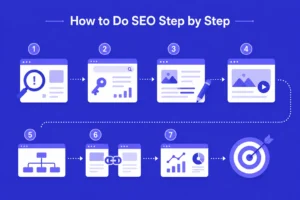
If you want to know how to do SEO step by step without getting buried in theory, here’s a sequence that holds up in practice.
- Audit your current site: Hunt down broken links, slow pages, and anything technical that’s blocking crawlers.
- Research keywords: Find out what people are actually typing into Google, then sort those terms by intent.
- Optimize existing pages: Rework titles, headings, and body copy around target keywords, without cramming them in.
- Create new content: Fill in the gaps with guides, FAQs, and pages that answer what customers keep asking.
- Build internal links: Connect related pages so users and crawlers can move around easily, something worth mapping out early in any website development process.
- Earn backlinks: Reach out for guest posts, partnerships, and mentions from sites that are actually relevant.
- Track and adjust: Use Google Search Console and GA4 to see what’s actually working, then tweak.
None of this happens fast. SEO rewards patience and consistency way more than it rewards a clever shortcut.
A Real-World Example
Take a small independent bookstore that just launched an online shop. For months, traffic came only from people who already knew the place existed, mostly locals who’d heard about it secondhand.
The owner sat down and looked at what customers were actually typing in, things like “best mystery novels for beginners” or “signed first editions near me,” instead of guessing. Category pages got rewritten around those terms. A blog went up tackling common reader questions. The site got quicker on phones too, thanks in part to a developer tightening up core web vitals improvements.
A few months in, pages that used to be invisible started showing up for those long-tail searches. New visitors, plenty who’d never heard of the store before, started arriving through organic search rather than only through repeat customers. That’s SEO at work, plain and simple: connecting people already looking with a business that can help them, no click purchased along the way.
How to Learn SEO for Beginners
Wondering how to learn SEO for beginners without spending a fortune? Good news, most of the foundational stuff is free.
- Start with Google’s own documentation on how Search works, straight from the source
- Practice on something real, even a personal blog, instead of only reading about it
- Get comfortable with Google Search Console and GA4 early; they’ll show exactly how pages are doing
- Follow a few reputable SEO blogs to keep up with algorithm shifts
- Watch AI search optimization trends too, since search behavior keeps drifting toward AI-generated answers
Still Googling what is SEO after finishing a guide like this one? Totally normal. It usually takes hands-on practice, not just reading, before any of it really clicks.
Common Mistakes Beginners Make with SEO
A handful of habits trip up beginners more than anything else out there.
- Keyword stuffing content until it reads unnaturally
- Ignoring mobile users, even though most searches happen on a phone these days
- Chasing backlinks from irrelevant or low-quality sites
- Publishing thin content that never fully answers the question it’s aiming at
- Skipping technical basics, like a complete website development checklist before launch, which tends to create SEO headaches that only surface months later
None of this guarantees top rankings on its own. But dodging these mistakes clears out a lot of the self-inflicted setbacks that hold new sites back early.
Final Thoughts
By now you’ve got a solid answer to what is SEO and a decent feel for how it fits into growing a website over time. It’s not a one-off project you finish and forget. It’s ongoing work, built on useful content, a technically sound foundation, often backed by custom web development built for speed and scale, plus real trust signals earned elsewhere on the web.
Running a personal blog or scaling a business, either way, an experienced search engine optimization team can shortcut a good chunk of that learning curve while you build the skills yourself alongside them.







 +91-7982030802
  +1(315) 585-1155